
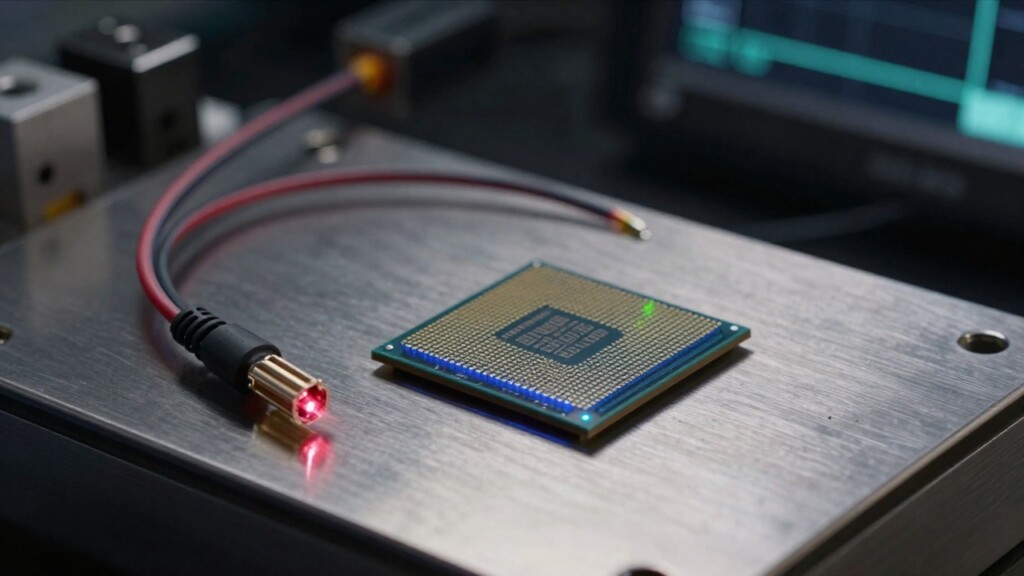
SPAD detectors (single-photon avalanche diode) are returning to the game in 2025 and 2026 as one of the most interesting development directions for process Raman spectroscopy. After a decade of slow maturation of silicon CMOS-SPAD arrays, several publications have emerged that genuinely push the boundaries — primarily in one dimension critical for industry: fluorescence suppression without the need to switch the excitation wavelength to expensive 1064 nm.
At Gekko Photonics, we design and manufacture process Raman analyzers in Poland — in inline, laboratory, and portable variants — so each new generation of detectors has specific design implications for us. In this review, we show what has actually emerged in recent months in the SPAD area and which threads are worth following if you are planning to implement Raman analytics in a reactor, pipeline, or production line.
SPAD in one paragraph — why it matters
A classic Raman detector is a thermoelectrically cooled CCD array of the back-thinned type (we wrote more about current lasers and detectors in our review of photonic innovations 2026). It works excellently for most process applications, but has one fundamental limitation: it integrates all photons that reach the pixel during the exposure time. If the sample exhibits fluorescence (and many real chemical media do — resins, oils, raw materials with contaminants), this fluorescence signal is tens of thousands of times stronger than the Raman spectrum and effectively buries it in noise.
SPAD changes the game because it operates in photon-counting mode with a time resolution on the order of hundreds of picoseconds. You can literally tell the detector: „count only photons that arrived within a 200 ps window after the laser pulse.” Raman scattering is practically instantaneous — fluorescence begins to emit only after several hundred picoseconds and decays over nanoseconds. A narrow time window cuts off fluorescence at the source before it even reaches the pixels. This approach is known as time-gated Raman and SPAD is its natural detector.
What has actually emerged in recent months
512-pixel CMOS-SPAD arrays in pixel-wise fast measurements (2025)
In June 2025, a paper was published in Biomedical Optics Express demonstrating a time-resolved Raman spectrometer system based on a 512-pixel linear CMOS-SPAD sensor with on-chip timing electronics. The team showed effective discrimination of pure paracetamol from a pharmaceutical mixture within a measurement time of about 30 seconds, with simultaneous suppression of both the fluorescence background and parasitic Raman signal from the probe's optical fiber itself.
The latter is significant for process applications — in an immersion probe with a long optical fiber (typically up to 100 m in our Spectrally X1 INLINE installations), part of the spectrum is generated in the quartz core itself and becomes a background that is difficult to subtract using chemometric methods. Time-gating cuts it off together with fluorescence.
Time-gated Fourier-Transform Raman with SPAD (March 2026)
The latest direction is a publication from March 2026 in Light: Advanced Manufacturing, showing a system combining a SPAD array with an FT-Raman interferometer. The configuration achieves a spectral resolution of 0.05 cm⁻¹ over a range of −1000 to 10,000 cm⁻¹ and a time resolution on the order of hundreds of picoseconds. Tests on PMMA and polystyrene microspheres coated with R6G fluorophore confirmed the separation of Raman and fluorescence signals in different time windows.
From a process application perspective, this is still a laboratory device — the interferometer and silicon SPAD array require environmental stabilization that is impossible to maintain in a reactor hall. But the direction is clear: SPAD is entering areas where classic CCDs and dispersive spectrometers have so far dominated.
Photon-counting micro-spectroscopy with two modalities (2025)
W In Light: Science & Applications.
, a paper was published in 2025 on time-resolved FT spectroscopy with simultaneous Raman imaging and fluorescence lifetime measurements. SPAD as a detector allows fluorescence to be treated not as an "enemy to suppress," but as a parallel information channel. For process analytics, this is a less obvious path, but in monitoring reactions involving fluorophores (e.g., in some pharmaceutical syntheses), such a two-dimensional approach makes sense.
Critical knowledge consolidation: review from IOPscience A good entry point is the review article by Kekkonen and co-authors in Measurement Science and Technology time-gated Raman (IOPscience), which organizes the entire family of techniques — from the first demonstrations in 2011 (300 ps pulses from a microchip Nd:YAG laser at 532 nm) to architectures with 256×8 and larger SPAD arrays. The review is especially valuable for an engineer who wants to understand the technical trade-offs imposed by each implementation: rectangular gate versus edge-triggered, laser pulse length versus SPAD time resolution, TDC circuits versus synchronous gating.
What SPAD is not yet changing in industry (and when it will change)
It must be honestly stated: in 2026, a typical process Raman analyzer still relies on a thermoelectrically cooled CCD array back-thinned, a CW laser (most often 785 nm, for demanding applications 1064 nm), and a classic dispersive spectrograph. SPAD remains in the advanced R&D segment and selected niche applications. Why?
- Requirement for a pulsed laser — time-gating requires a laser generating pulses below 100 ps. This significantly increases cost, complexity, and service requirements compared to a simple CW diode laser.
- Synchronization stability — the „pulse + gate” system must maintain picosecond synchronization for thousands of hours of operation in a process environment (vibrations, temperature changes, electronics aging).
- Quantum efficiency of a single SPAD pixel still lags behind a well-prepared CCD array back-thinned for applications without a fluorescence problem. For most process chemistry, where fluorescence is moderate, a classic detector plus chemometrics still wins in terms of signal-to-noise ratio per unit time.
- Maturity of chemometric models — in a production process, a repeatable base of PLS/CNN models validated over years is what counts. Changing the detector means re-calibrating every model, which for many clients is too great an operational risk.
The realistic moment when SPAD will enter process Raman analyzers is likely for applications with strong fluorescence (black oils, dark resins, polymer recyclate, some fertilizers), for which current solutions require an expensive 1064 nm laser. Time-gated Raman with 785 nm and SPAD may prove to be a cheaper alternative — but only when the pulsing electronics shrink to a size and cost comparable to a CW laser module.
What this means for an implementation decision „today”
If you are currently planning to implement Raman analytics in a chemical, polymer, or cosmetic process, more important than „when SPAD” are two questions:
- Does your medium fluoresce? A feasibility study on samples from the line should provide a clear answer. If the spectrum is clean — a classic CCD back-thinned is a rational CAPEX choice.
- If it fluoresces — can chemometrics handle it? PLS models with preprocessing (SNV, derivatives, baseline correction) plus algorithmic fluorescence suppression cover the vast majority of real cases. Only when these methods fail is it worth discussing 1064 nm or time-gating.
For applications where fluorescence is so strong that both of the above paths fail, it is worth following two technological lines: CMOS-SPAD arrays of the line sensor type (soon to appear in selected commercial systems) and 1064 nm lasers with an InGaAs detector (a mature technology, but with a different limitation — lower Raman cross-section at longer wavelengths).
Gekko Photonics solutions for fluorescence-sensitive applications
At Gekko Photonics, we build process Raman analyzers around 785 nm lasers and CCD detectors back-thinned, because this combination realistically wins most battles for signal-to-noise ratio in industrial media. For applications where fluorescence is a problem, we first reach for tools that deliver a reliable result on a scale of weeks, not quarters:
- Feasibility study on client samples — we check the spectrum Spectrally X1 LAB under controlled laboratory conditions before anyone discusses CAPEX and process configuration.
- Chemometric tuning in Spectrally OS — a library of approximately 28,000 reference spectra and PLS/CNN/PCA models allow us to extract significantly more from 785 nm than a „default” measurement suggests.
- Inline measurement 24/7 in the reactor — Spectrally X1 INLINE with the Retractex probe maintains a clean optical window even in challenging media (resins, viscous liquids, deposits), which eliminates a significant portion of issues distinguishable from „fluorescence” in the spectrum.
- Field verification — Spectrally X1 PORTABLE allows rapid comparison of the production line spectrum with the laboratory library before a PASS/FAIL decision.
If SPAD and time-gated Raman detectors prove to be the only sensible path for your application, we will tell you so in the feasibility study — and indicate a path to adopting this technology without the risk of making a decision today that will need to be revised in a year. The same applies to the entire family of process analyzers: wavelength selection, laser power, detector type, and probe choice always start from the specific chemistry, not from a product catalog.
What not to listen to in press releases
Two pitfalls that persistently recur in Raman detector marketing should be treated with skepticism:
„SPAD eliminates fluorescence 100%”. No. Time-gated SPAD suppresses fluorescence very effectively, but requires matching the time window to the fluorophore lifetime in a given sample. For fluorophores with lifetimes shorter than the laser pulse (rare but possible), suppression decreases.
„Time-gated Raman will replace CCD in industry by 2027”. It will not replace it. It will replace it in selected applications with strong fluorescence — in others, the classic 785 nm + CCD back-thinned + chemometrics path will remain dominant, for the simple reasons of cost and operational simplicity.
A credible signal that SPAD is entering the process mainstream is not a press headline, but its presence in a commercial catalog with process parameters (IP54/IP65, ATEX, guaranteed synchronization stability for 5+ years). We are still far from that state, but each successive publication in 2025–2026 brings the industry one step closer.
Frequently asked questions
How does a SPAD detector differ from a CCD array in Raman spectroscopy?
SPAD operates in single-photon counting mode with time resolution on the order of hundreds of picoseconds, enabling gated detection within a very narrow time window immediately after the laser pulse. CCD back-thinned integrates all photons over the entire exposure — it is generally more quantum-efficient for samples without fluorescence, but cannot separate Raman from fluorescence in time.
Does SPAD require a pulsed laser?
Yes, if the goal is time-gated Raman. Practical implementations use pulsed lasers with pulse durations below 100 ps and repetition rates on the order of MHz. This significantly increases the overall system cost compared to a CW diode laser.
Do process Raman analyzers already use SPAD in 2026?
Commercial inline process analyzers in 2026 still overwhelmingly use thermoelectrically cooled CCD arrays back-thinned. SPAD remains in the domain of advanced R&D, selected academic systems, and a few niche configurations. It is worth following the development, but not worth delaying process analytics implementation „until SPAD matures”.
What Raman analyzers does Gekko Photonics offer, and do we handle fluorescence applications?
We offer the Spectrally X1 family: X1 INLINE (continuous measurement in the reactor, Retractex probe), X1 LAB (QC laboratory, 25-sample carousel), X1 PORTABLE (mobile verification) and a software platform Spectrally OS with CNN/PLS/PCA models. For fluorescence applications, we start with a feasibility study on your samples — we check whether 785 nm + chemometrics yield sufficient results, and if not, we openly discuss alternatives (1064 nm, time-gated approaches).
What is the next step if I am considering Raman analytics in my process?
At Gekko Photonics, we select the analyzer configuration in a 30-minute conversation with an application engineer — without a marketing presentation, with a specific set of questions about the medium, process conditions, and success metrics. We perform a test measurement on client samples typically within 2 weeks of receiving the material. Schedule a consultation via contact page or email at spectrally@gekkophotonics.com.