
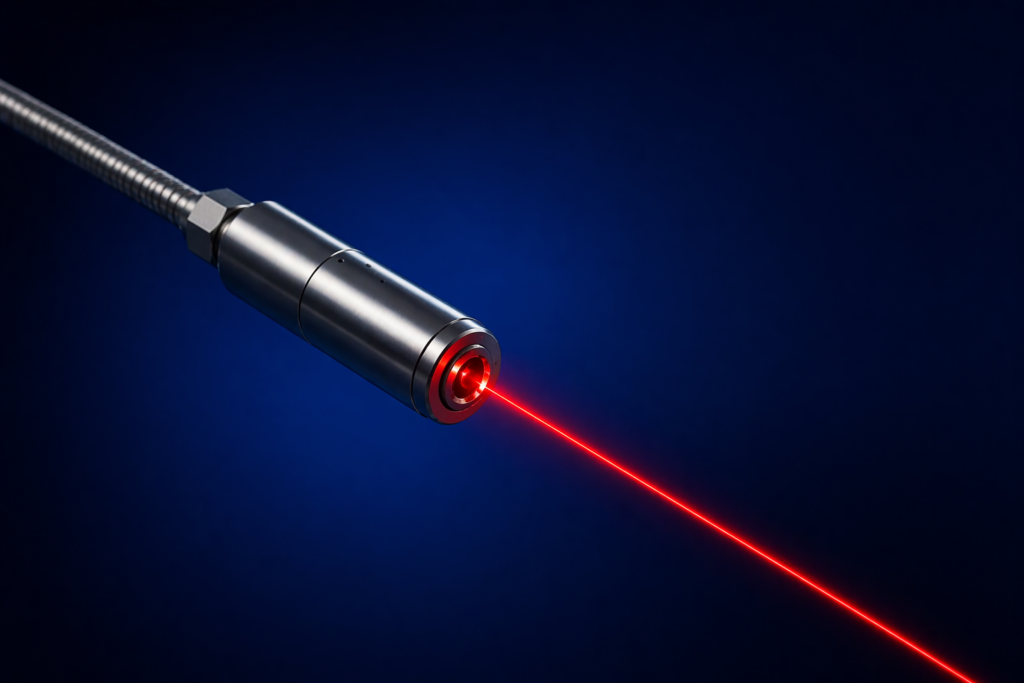
What has the latest wave of laser and detector premieres for process Raman revealed?
The past few weeks have brought several specific technological signals from the area of laser sources and photon detectors used in Raman spectroscopy. For teams responsible for Process analyzers and maintenance engineers in the chemical industry, these are not purely academic novelties — each has the potential to impact the architecture of inline measurement in a reactor, distillation column, or mixing line.
We assess this review of innovations in OEM lasers and detectors from the perspective of a maintenance practitioner: which changes in sources and detectors actually translate into the selection of analyzer configurations for a specific process, and which, for now, remain in the laboratory.
In this article, we review two paths of change that are clearly visible in industry communications from April 2026: first, industrial OEM lasers with shorter wavelengths adapted for standard silicon detectors; second, the maturation of single-photon detectors (SPDs), including superconducting nanowire single-photon detectors (SNSPDs), which open a window for samples that are challenging for classical CCD or EMCCD.
The goal is purely engineering: what do these technological signals mean for a chemical line where an inline Raman analyzer is expected to operate 24/7 for years to come.
OEM 405 nm laser — why is „blue” Raman returning to process discussions?
In April 2026, a leading European OEM laser manufacturer announced a redesigned 405 nm platform with an output power of up to 100 mW, dedicated for integration into industrial Raman spectrometers. The thesis recurring in communications: 405 nm provides a strong Raman signal because the intensity of the scattered signal scales with the fourth power of the excitation frequency, while the Stokes spectral range (up to approx. 1000 cm⁻¹ shift) falls entirely within the sensitivity range of a standard silicon detector (Si-CCD, Si-CMOS).
Practical consequences for the process analyzer designer: no need for more expensive InGaAs arrays or cryogenic cooling, lower BOM, simpler calibration at the plant, and faster field service. These are arguments that carry real weight for an OEM integrator.
405 nm is not, however, a miraculous wavelength for industrial chemistry. A shorter wavelength entails a higher risk of background fluorescence, and thus a bane for most organic media: phenol-formaldehyde resins, polyols, products petrochemical, dyed polymers. Therefore, 405 nm is primarily employed in processes where the sample is „optically clean”: inorganic salts, electrolyte solutions, solvents without conjugated rings, and technical gases. Most chemical and polymer applications remain the domain of 785 nm and 1064 nm. The movement in the 405 nm OEM laser market, however, shows growing interest in Raman in niches where fluorescence is not a problem, and unit cost and analyzer TCO are significant.
SPD and SNSPD detectors — what is maturing in the area of „photon-starved” Raman?
The second thread recurring in publications from recent weeks is the scaling of single-photon detector arrays — especially superconducting nanowire single-photon detectors (SNSPDs). Superconducting nanowires allow registering single photons with detection efficiency on the order of 90%, dark noise at the level of single events per second, and temporal resolution below 50 ps. Reviews and communications appearing in the first quarter of 2026 show that SNSPDs are moving from single pixels towards true imaging arrays.
For process Raman, the implications are indirect but interesting. Raman is an inherently „photon-starved” technique — only on the order of one in 10⁶–10⁸ photons scatters inelastically. In typical process chemistry, this problem is solved by wavelength selection, back-scatter probe optimization, and chemometrics, allowing sub-second measurements at 100–500 mW at the probe tip. However, in specific applications — trace gas measurement, monitoring of very dilute contaminants, measurement of layers with very small scattering cross-sections — an order-of-magnitude improvement in detector quantum efficiency begins to matter. Today, SNSPDs live mainly in biomedical imaging, FLIM, and quantum lidars, with a price tag at the level of specialized systems. But this is the same maturation curve that cooled InGaAs arrays for 1064 nm underwent a few years ago — and that is why this market is worth watching.
What to verify during the next Raman analyzer audit?
From an engineering perspective, it is worth verifying quarterly whether the analyzer configuration still corresponds to the current process and its quality goals. A checklist for review:
- Excitation wavelength: 785 nm for most organic chemistry, 1064 nm for fluorescing samples (resins, petrochemicals, dark substrates), 532 or 405 nm for optically clean solutions and gases.
- Laser power at the sample: typically 100–500 mW; the lower limit is constrained by noise, the upper limit by photodegradation and thermal stability of the probe.
- Detector: Si-CCD or CMOS up to ~1050 nm, EMCCD at low light levels, InGaAs for 1064 nm excitation, SPAD and SNSPD for photon counting applications.
- Acquisition time and averaging: 100 ms – 30 s depending on concentrations and process dynamics.
- Spectral resolution: 4–8 cm⁻¹ for process chemistry, 1–2 cm⁻¹ for thin polymorphic bands and qualitative identification of crystalline forms.
- Probe type: back-scatter with immersion window for reactors and pipelines, transmission for tablets and emulsions, immersion for liquids in buffer tanks.
- IT/OT integration: 4–20 mA outputs for classical control, Modbus TCP/RTU for PLCs, OPC UA and Profinet for newer DCS and MES.
Gekko Photonics Solutions in Raman Spectroscopy
Gekko Photonics' portfolio includes four coherent product lines dedicated to Raman spectroscopy in the chemical industry. Spectrally X1 INLINE An in-line process analyzer with a 785 nm laser and a TE-cooled back-thinned CCD detector, featuring an immersion probe and PROFIBUS/PROFINET/GSM communication, available in an ATEX version (laser power limited to 30 mW). Spectrally X1 LAB is a laboratory and at-line variant intended for method validation, batch QC, and reference analysis. Spectrally X1 PORTABLE is a portable version for audits, diagnostic measurements at the client site, and rapid screening. The entire system is integrated with a chemometric platform Spectrally OS, which supports PLS, PCA, SVM models, as well as neural network architectures for more challenging spectral datasets.
For the subject of this article—laser and detector selection—the Spectrally X1 family is standardly available in two excitations: 785 nm 600 mW (TE-cooled back-thinned CCD detector) and 1064 nm 800 mW (detector for strongly fluorescent media), both variants operating within the same chemometric platform. Spectrally OS. The short-wavelength 405 nm lasers discussed above are outside the standard offering and are considered on a design basis, following feasibility consultation on customer samples.
Production, calibration, and servicing of the analyzers are carried out in Poland. Integration of the Spectrally X1 with control systems is achieved via PROFIBUS, PROFINET, and GSM—depending on the DCS/PLC architecture at the customer’s facility.
FAQ
Will the new 405 nm lasers replace classical 785 nm and 1064 nm in process Raman?
Not in the majority of organic chemistry applications. For resins, polymers, petrochemical products, and dark substrates, fluorescence at 405 nm is too significant a barrier. 405 nm OEM lasers find their place in niches: inorganic salts, electrolytes, technical gases, optically clean solutions — that is, where a silicon detector suffices and analyzer cost is a major factor.
What real benefits does SNSPD offer in process spectroscopy?
Currently marginal for typical process chemistry. SNSPDs excel where single photons and temporal resolution below 50 ps matter: biomedical imaging, FLIM, quantum lidars. In inline measurement, the process is usually measured with a dense signal and sub-second acquisition time, so mature CCD, EMCCD, or InGaAs arrays are sufficient. However, this market is worth observing — its scaling will open up new classes of trace measurements.
What does „standard silicon detector” mean in laser manufacturer communications for the person responsible for inline measurement?
Simply put: the detector array does not require exotic material (e.g., InGaAs) or cryogenic cooling. In practice, this translates to a cheaper analyzer, simpler serviceability at the plant, and availability of spare parts from many laboratory optics suppliers.
How often should the laser-detector configuration of an existing analyzer be verified?
We recommend a review every 6–12 months, and mandatory after a major change in recipe, raw material, or process temperature. If the process evolves (new additives, new concentrations), chemometric models, the optical path, and bandpass filters may require updating before prediction quality begins to decline.
What Raman analyzers does Gekko Photonics offer for monitoring chemical processes?
Gekko Photonics delivers five catalog products: Spectrally X1 INLINE (inline process, laser 785 nm 600 mW or 1064 nm 800 mW, TE-cooled back-thinned CCD detector, ATEX variant with laser power limited to 30 mW), Spectrally X1 LAB and LAB+ (at-line and laboratory, same excitation set; LAB+ with a library of ~28,000 reference spectra), Spectrally X1 PORTABLE (portable for audits and screening), Spectrally X1 PROBE (IP67 immersion probe, ATEX/IECEx Zone 0, with self-cleaning Retractex component for challenging media), and Spectrally OS (chemometric platform with PLS, PCA, SVM models and neural networks). Manufacturing, calibration, and service are conducted in Poland, and integration of Spectrally X1 with DCS/PLC is achieved via PROFIBUS, PROFINET, and GSM.
Summary and contact
The launches of OEM 405 nm lasers and advances in SNSPD arrays, evident in recent announcements and publications, do not immediately transform the entire world of process analyzers in chemistry, but they provide specific arguments for re-evaluating the laser-detector configuration. For most production lines, 785 nm or 1064 nm with a Si-CCD or InGaAs detector remains the standard; newer short-wavelength lasers and single-photon arrays have the potential to work in niche and trace applications.
If you are considering an audit of an existing analyzer or a new inline project, contact our application team —we will schedule a 30-minute discussion with a Gekko Photonics engineer and propose a test measurement on your sample within two weeks. For existing Raman installations, we also conduct service visits and diagnostic audits at facilities in Poland and the EU.