
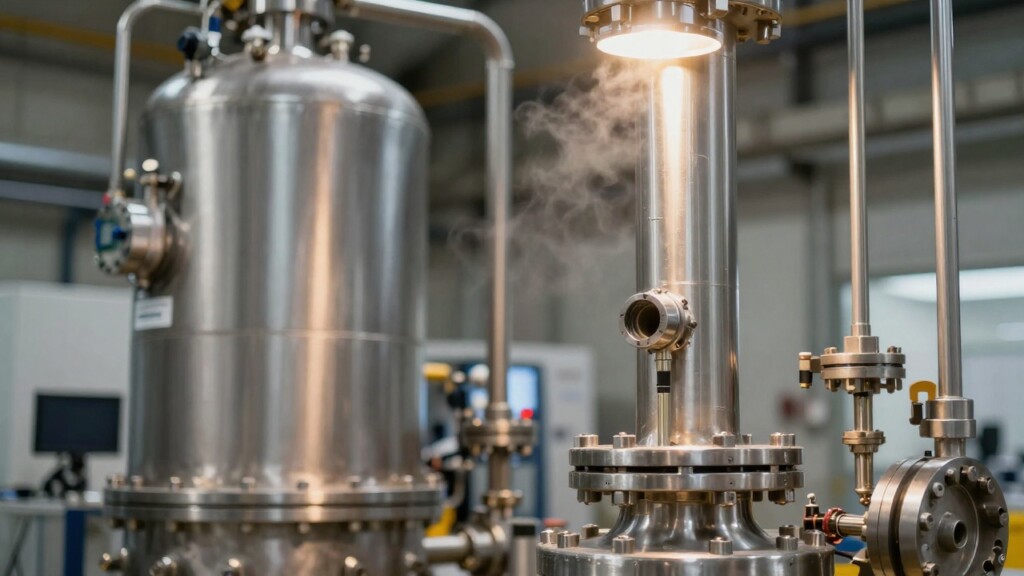
PAT (Process Analytical Technology) It originated from pharmacy, but today the largest field of application is specialty chemicals: resins, surfactants, adhesives, coatings, polymers, cosmetic formulations, fertilizers. In these areas, formulations are multi-component, batches are short, and the cost of a failed batch runs into tens of thousands of euros. It is precisely in specialty chemicals that we see the fastest return on PAT implementations — and here, as Gekko Photonics, we have the highest number of implementations. This article is a practical guide: what PAT really is, what layers a functioning system must have, which analytical techniques to choose, and what design errors we most frequently encounter in discussions with process engineers.
What is PAT and why it emerged in pharmaceuticals
PAT is an approach to designing and conducting a production process in which product quality is managed during manufacturing, not merely checked after its completion. The initiative was launched by the U.S. Food and Drug Administration (FDA) in the early 2000s, and the doctrinal canon is defined by the ICH Q8–Q10 guidelines (Quality by Design, Pharmaceutical Quality System) and subsequent extensions concerning Real-Time Release Testing.
The four pillars that have transferred from pharmaceuticals to other industries are:
- Process Understanding — identification of Critical Quality Attributes (CQAs) and Critical Process Parameters (CPPs)
- Measurement During Manufacturing — inline/at-line sensors instead of taking a sample to the laboratory
- Model-Based Control — chemometric models linking the raw signal (e.g., Raman spectrum) to a process variable
- Continuous Improvement — historical data used to tune formulations and detect drift
In pharmaceuticals, PAT was driven by regulatory pressure. In specialty chemicals, the pressure is business-driven: reduction of cycle time, reduction of rework, elimination of costly laboratory analyses, better batch reproducibility.
Why PAT is relevant for specialty chemicals
Specialty chemicals is an area where the laboratory model of „take a sample, send it to QC, wait 2–8 hours for a result” is the worst possible approach. Reasons why PAT is genuinely profitable here:
- Short batches (typically 2–8 hours) — by the time the laboratory result returns, the reaction has already completed its critical stage, and the sample is historical
- Multi-component formulations — simultaneous measurement of 3–6 analytes saves weeks of QC work
- End-point sensitivity — in FF/UF resins, alkyds, acrylates, the moment of polycondensation completion determines the viscosity and application properties of the final product
- Difficult media — high viscosity, hot mixtures, suspended phases — obtaining a representative sample without disturbing the process can be technically unfeasible
- Cost pressure — reduction of laboratory costs by up to 80% and improvement of OEE by several percentage points are tangible return indicators
In this group, natural candidates for PAT are phenol-formaldehyde and urea resin processes, polymerization of acrylates and alkyds, surfactant formulation (SLES, glycerin, water:ethanol), adhesive and coating production, and the production of AdBlue, RSM, and urea.
The PAT stack — what constitutes a functioning system
Implementing PAT in specialty chemicals is not a single „analyzer.” It is a full stack of layers — hardware, software, and procedures — each element of which must fit the specific process topology.
- Probe and sampling point — immersion probe in the reactor, flow-through probe in the pipeline, transmission probe in the measurement cell window; the choice determines signal repeatability under changing process conditions
- Analyzer (optical front-end) — excitation source (785 nm laser for most process applications), detector (thermoelectrically cooled back-thinned CCD array), spectrograph, acquisition time typically 5–300 s
- Communication layer — process interface to DCS/MES, most commonly PROFIBUS, PROFINET, or GSM for distributed installations
- Chemometrics and models — PLS, PCA algorithms, CNN networks for difficult-to-separate mixtures; reference spectral libraries for raw material identification
- Operational workflow — trend visualizations, alarms, reporting, model drift monitoring, integration with electronic batch documentation
The most common design error is viewing PAT as „buying a device.” In reality, it is a set of competencies distributed across five layers — omitting any one of them (typically: chemometrics or communication with the DCS) turns the project into a shop window display.
Analytical techniques — what to choose
In specialty chemicals, three spectroscopic techniques are most commonly considered (NIR, MIR, Raman) plus classic process sensors (pH, refractometry, conductivity, viscosity).
- Raman Spectroscopy Raman
- — very high chemical specificity, direct measurement in aqueous media (water does not generate a strong background), compatibility with glass/sapphire in the probe window, compatibility with fiber optic probes up to 100 m. Works well for resins, polymers, surfactants, raw material identification NIR
- — fast, inexpensive, good for global parameters (moisture, solids content), weaker specificity for chemically similar mixtures; strong water background MIR (ATR/FTIR)
- — very high specificity, but requires contact of the ATR crystal with the medium, problematic cleaning, weaker signal transmission distance Classic process sensors
W — complement the picture (viscosity, temperature, pressure), do not replace composition measurement In an article comparing laboratory Raman with process Raman.
we show why spectral measurement alone is not sufficient — the key lies in the chemometrics and process integration layers. This is the same pattern seen in a full PAT implementation.
Implementation challenges — where projects fail
From our feasibility workshops, three areas generate over 70% of implementation difficulties:. 1. Chemometric model drift.
A model trained on data from the first 3 months begins to "drift" from reality after a change in raw material batch, reactor upgrade, or pH change. Without drift monitoring and a retraining policy, the model can systematically deviate by several percent after a year. 2. Integration with DCS/MES.
Classic error: the analyzer sits on the line, measures, displays a spectrum on the screen — but the operator in the control room does not see the CQA values in the process trend. Without closing the communication loop (PROFIBUS/PROFINET → DCS → SCADA → MES), the analysis remains a "blind indicator" alongside the process, not a part of it. 3. Validation and maintenance.
Gekko Photonics solutions for PAT in specialty chemicals
W Gekko Photonics We deliver a full PAT stack based on Raman spectroscopy — hardware, software, chemometric models, and implementation support as one cohesive offering.
- Spectrally X1 INLINE — Process Raman analyzer for continuous measurement directly in a reactor or pipeline. 785 nm laser, 600 mW power (30 mW for ATEX-rated version), spectral range 300–1650 cm⁻¹, resolution 8 cm⁻¹, thermoelectrically cooled CCD detector, up to two measurement channels, PROFIBUS/PROFINET/GSM communication, fiber optic cable up to 100 m. Self-cleaning probe. Retractex Solves the problem of challenging media (resins, viscous liquids, deposits on the probe window).
- Spectrally X1 LAB — Laboratory benchtop analyzer for model validation and raw material control. 25-position carousel, through-package analysis, shared models with the inline version. Practice shows that approximately 60% of a chemometrician's time is spent in the laboratory — preparing training data, verifying raw materials, and fine-tuning models before they are deployed on the line.
- Spectrally X1 PORTABLE — Portable analyzer for mobile raw material identification at the warehouse gate, audits on the production floor, and field model validation. IP54, standalone touchscreen, measurement time 5–300 s.
- Spectrally OS — Software layer common to the entire X1 family. Chemometric models (PLS, PCA, CNN), library of approximately 28,000 reference spectra, workflow automation, data export (CSV, PDF, RAW), access control (RBAC), trend and model drift monitoring, integration with DCS via industrial interfaces.
Our implementation practice: we begin with a feasibility study on the client's samples in the Spectrally X1 LAB, validate the model, and only then transfer it to the Spectrally X1 INLINE under process conditions. Typical time from the first workshop to a production-ready system is within 3–5.5 months. ROI in typical specialty chemical applications is achieved within 6–10 months.
More context on the inline architecture itself can be found in the article on types of inline process analyzers, and on the regulatory side of PAT/QbD in the overview of PAT/QbD regulations from 2026. The full category with our hardware and software offering is available on the page /analyzers.
FAQ — frequently asked questions
Is PAT only for large pharmaceutical plants?
No. Historically, the concept was introduced in pharmacy, but today the largest application field is specialty chemicals, polymer recycling, cosmetics, fertilizers, biofuels. The fundamental scheme — real-time measurement, chemometric model, integration with DCS — is exactly the same.
How long does a full PAT implementation with Raman take?
In our experience, typically 3–5.5 months from the first feasibility workshop to production startup. Decisive factors: availability of representative samples for model training, readiness of process infrastructure (nozzles, power supply, cable pathways), and the time required for the process technologist to approve the chemometric model.
Does Raman always work as a PAT technique in chemistry?
Not always. For global parameters such as moisture, dry mass, or density — NIR is often sufficient and more cost-effective. Raman wins where chemical specificity is needed, for simultaneous measurement of multiple analytes in a mixture, operation in aqueous media, or low background fluorescence. In practice, technique selection is part of the feasibility workshop — we verify the spectral signature of the client's specific analytes before declaring that Raman will work.
What does Gekko Photonics offer in the area of PAT for specialty chemicals?
We deliver a full stack: a process Raman analyzer (Spectrally X1 INLINE), a laboratory unit for model validation (Spectrally X1 LAB), a portable version for mobile verification (Spectrally X1 PORTABLE), and a shared software platform (Spectrally OS) with ready-made chemometric models, a library of approximately 28,000 reference spectra, and interfaces to DCS/MES. Additionally, we conduct a feasibility study on client samples before CAPEX — to verify the method’s fit to the specific process topology.
Does the Spectrally X1 INLINE operate in media with a risk of deposits on the probe window?
Yes. For resins, viscous liquids, and media with a suspended phase, we use the module Retractex — a self-cleaning probe periodically retracts from the process, the optical window is flushed, and the probe returns to the measurement position. The cycle is synchronized with process phases to avoid interfering with critical measurement points.
Test measurement and engineering consultation
At Gekko Photonics, we tailor the PAT configuration to the specific process topology — we do not sell a „box off the shelf.” The first step is a 30-minute conversation with our application engineer, where we discuss the chemistry, critical quality attributes, available sampling points, and infrastructure limitations. We perform a test measurement on samples from your process in our laboratory, typically within 10 business days of receiving the samples. The result is a spectral report with a feasibility assessment, a proposed hardware configuration, and a preliminary quotation. Write to us — describe your process in 3–4 sentences, and we will get back to you with a proposed consultation date.