
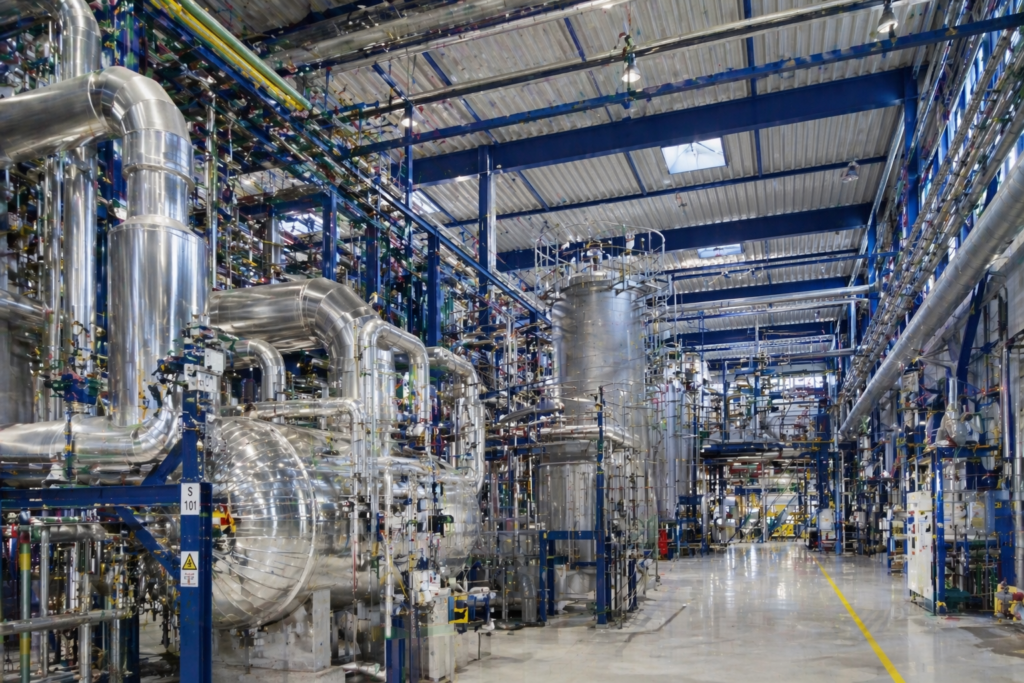
An inline process analyzer is no longer an option, but a standard in plants where a control decision must be made within seconds, not hours, from sample collection to laboratory result. Instead of the classic cycle of „sample — transport — analysis — report,” measurement takes place directly in the reactor, in a pipeline, or in a flow cell integrated with the production line. The measurement probe emits light, the detector records the spectrum, and a chemometric algorithm translates it into concentration, density, temperature, or another parameter used by the DCS for real-time process control.
W Gekko Photonics We design in-line process analyzers in Poland — from single probes in reactors to multi-channel architectures on production lines. We also perform calibration and servicing ourselves. Process analyzers, with integration into control systems via industrial standards (4–20 mA, Modbus TCP, OPC UA, Profinet). In this guide, we organize the decisions worth considering before selecting a specific configuration, regardless of the process industry.
The text is written with process engineers, technologists, automation specialists, and those responsible for CAPEX in mind. We deliberately omit marketing slogans and focus on what changes the choice between one option and another at the datasheet level.
How an inline analyzer differs from at-line and laboratory analyzers
Terms inline, on-line, at-line i off-line are frequently mixed up, yet they have different consequences for the measurement cycle, maintenance, and line architecture.
- Inline — the probe is introduced directly into the process medium (reactor, pipeline). No sample extraction, no transport delays, continuous measurement or measurement at second-level frequency.
- On-line / bypass — the sample is passed through a side circuit (loop), where a flow cell or probe is located. The measurement is still automatic, but the sample „sees” slightly different conditions (temperature, pressure) than the reactor.
- At-line — the sample is manually or automatically delivered to an instrument located in the control room or near the line. Response time: minutes.
- Off-line / laboratory — classic process laboratory. Response time: hours to days.
Inline provides a short feedback loop and high data quality for the control model, but requires a probe that withstands process conditions and, in hazardous areas, a certified enclosure (ATEX/IECEx). At-line is simpler to maintain but is not suitable for controlling fast reactions.
Main types of inline process analyzers
The answer to the question „which analyzer to select” always begins with an analysis of the molecule and the matrix in which it is measured.
Raman Spectroscopy
Raman measures the inelastic scattering of laser light (Raman effect) and is particularly effective for covalent molecules—hydrocarbons, polymers, resins, and pharmaceuticals. Water produces a weak Raman spectrum, making the technique highly suitable for aqueous solutions (SLES, glycerin, urea, battery electrolytes). Standard excitation: 785 nm (a practical compromise between sensitivity and fluorescence) or 1064 nm (minimizing fluorescence in colored matrices). Immersion probes made of stainless steel, Hastelloy, or Inconel with sapphire windows are a proven solution for aggressive media.
NIR spectroscopy (near-infrared)
NIR measures overtones and combinations of O–H, N–H, C–H vibrations. It is cheaper and faster than Raman for determining moisture, fat, and protein in food applications and powder production. However, it has limitations for aqueous solutions (strong water signal dominates the spectrum) and for molecules without X–H groups.
FT-IR spectroscopy (mid-infrared)
FT-IR offers very strong, selective spectra but requires special windows (ATR, ZnSe) and has a limited optical path for solutions. It is often used in laboratory and pilot reactors; in inline process applications, it competes with Raman in heavy-duty applications, though it imposes more mechanical constraints.
UV-Vis and fluorimetry
Fast, inexpensive, but with low selectivity. Suitable for simple determinations (dye concentration, oxidizers, selected proteins). Often used as a complement to Raman or NIR.
Gas analyzers
Inline TDLAS (tunable diode laser absorption spectroscopy), NDIR, paramagnetic oxygen analyzers. Dedicated to flue gases, reactor atmosphere, and off-gases.
Electrochemical and conductometric sensors
The oldest class. pH, ORP, conductivity, dissolved oxygen. Inexpensive but non-selective — indispensable for single parameters, but not for the chemical profile of an entire mixture.
Measurement architectures — how to integrate the probe with the line
After selecting the technique, one must decide, where i and how to introduce the measurement. The same process analyzers can operate in very different configurations.
Insertion (immersion probe)
Classic probe with an optical window introduced through a nozzle in the reactor or pipeline. Advantages: no additional infrastructure, measurement exactly under process conditions, simple maintenance. Requirements: tightness (PN-rating), chemical compatibility of seals and window, service access. In Raman, typical immersion probes have a length of 200–400 mm and withstand 40–150 bar / up to 300 °C.
Bypass / side stream
The sample is diverted to a side circuit with a smaller cross-section, where a flow cell or probe is installed. Advantages: easy service without interrupting reactor operation, possibility of sample preparation (filtration, temperature conditioning). Disadvantages: slightly different conditions than in the reactor, longer path from the sampling valve to the cell (measurement delay).
Flow cell — transmission and back-scatter
Flow cells with two optical windows (transmission) provide a very good signal for clear liquids; the back-scatter configuration works well for suspensions and emulsions. Transmission measurement requires precise adjustment of the layer thickness (typically 0.5–10 mm).
Non-contact / stand-off
The probe observes the surface (e.g., production belt, granulate, powder in free fall) through a window. Working distance: 5–250 mm. Installation convenience, but sensitivity to changes in product geometry and optical contamination.
Multi-point / multi-probe architecture
One analyzer serves several probes simultaneously (optical switch or multiplexing), significantly reducing the cost per measurement point. Used in multi-component reactors, reactor batteries, and continuous lines.
Typical technical parameters — what goes into the specification
The following list of parameters realistically differentiates process analyzer models from one another. Manufacturers often describe „sensitivity” as a single number, whereas for the process, a specific set of datasheet values is important.
- Excitation wavelength (Raman): 532 nm (laboratory), 785 nm (process standard), 1064 nm (fluorescent matrices, resins, oils).
- Laser power: 100–500 mW at the probe in process; lower power = longer acquisition time, higher power = risk of sample photodegradation.
- Detector: CCD (standard for 785 nm), EMCCD (very weak signal), InGaAs (1064 nm), SPAD (ultra-fast measurements, ns timescales).
- Spectral resolution: 4–8 cm⁻¹ for most processes; higher resolution only where spectra are narrow and closely spaced (e.g., isomer identification).
- Spectral range: 100–3400 cm⁻¹ at 785 nm (fingerprint + C–H stretching band).
- Single spectrum acquisition time: 1–60 s; in practice, a compromise between SNR and process dynamics.
- Probes: back-scatter (most common), transmission (clear liquids), immersion (reactor).
- Protection class and Ex zone: IP65–IP67 for the probe head, ATEX zone 1/21 or zone 2/22 certifications, IECEx for EU and international installations.
- Interfaces to DCS/PLC: 4–20 mA, Modbus TCP, OPC UA, Profinet, Ethernet/IP.
- Operating temperature: enclosure −20 °C to +55 °C; probe up to +300 °C / 200 bar (material variants).
- Chemometric software: PLS, PCA, SVM, neural networks; model validation, versioning, audit trail (required for pharmaceuticals).
Checklist for selecting an inline process analyzer
Before ordering your first demonstration, it is worth going through the list below — it will save at least two quarters of specification wandering.
- Target molecule — is it active in Raman, NIR, or IR?
- Matrix — water, organic solvent, emulsion, gas, powder?
- Concentration range and process dynamics — from ppm to percent; typical rate of change.
- Process conditions — T, p, viscosity, suspended solids, background fluorescence.
- Ex zone — ATEX 1/21, 2/22, or safe area? Certifications required in EU/US?
- Integration with DCS — protocol, number of values, control loop timing.
- Validation plan — CSV, GxP, PAT framework for pharmaceuticals.
- Service — SLA, local engineer availability, calibration schedule.
- 5-year TCO — purchase cost + maintenance + laser replacement + chemometric model development.
- Contingency plan — procedure in case of analyzer failure, manual sampling, interlocks.
Gekko Photonics Raman analyzers
Gekko Photonics designs Raman analyzers optimized for inline measurements in chemical and pharmaceutical processes. The portfolio includes four complementary platforms, selected according to the specific use case.
- Spectrally X1 INLINE — Process Raman analyzer for continuous installations. Laser 785 nm 600 mW or 1064 nm 800 mW, TE-cooled back-thinned CCD detector, Spectrally X1 PROBE immersion probe (IP67, ATEX/IECEx Zone 0) with self-cleaning Retractex component, PROFIBUS / PROFINET / GSM communication, ATEX variant with laser power limited to 30 mW. The architecture standardly supports up to 2 measurement channels from a single analyzer (expansion upon request); probe material configurations are project-selected for chemical compatibility with the process.
- Spectrally X1 LAB — at-line and laboratory analyzer for method validation, inter-operational quality control, and chemometric model development prior to inline deployment.
- Spectrally X1 PORTABLE — portable version for process audits, raw material identification in warehouses, and quick checks at multi-site plants.
- Spectrally OS — chemometric platform supporting PLS, PCA, neural network models, model versioning, audit trail and integration with DCS/MES/SCADA.
For the topic of this guide — inline process analyzers — the most commonly considered configuration is Spectrally X1 INLINE with immersion probe Spectrally X1 PROBE in a reactor or pipeline, and Spectrally OS as a chemometric layer linking spectra with control values in the DCS. In the Spectrally X1, both standard wavelengths — 785 nm 600 mW and 1064 nm 800 mW — are available as catalog items; the selection is made during the feasibility phase on real samples. 785 nm remains the first choice for most organic chemistry, while 1064 nm is used where background fluorescence dominates. Shorter wavelengths (532 nm, 405 nm) are outside the standard offering and are considered on a project basis. The architecture (single vs. multi-probe) depends on the number of points and process dynamics.
Production, calibration, and service in Poland. Integration of Spectrally X1 with the DCS is carried out via PROFIBUS, PROFINET, and GSM (the 4–20 mA, Modbus TCP, and OPC UA protocols popular in the industry were discussed earlier, but the standard communication for the X1 family is PROFIBUS / PROFINET / GSM). Gekko Photonics also supports the chemicals and polymers industry, petrochemical, pharmaceutical, and environmental monitoring.
FAQ — frequently asked questions about inline process analyzers
What is the difference between an inline analyzer and an on-line analyzer?
Inline means measurement directly in the process medium — the probe is immersed in the reactor or pipeline. On-line (often used synonymously) means automatic measurement without operator intervention, but the sample may be passed through a side circuit (bypass). In practice, the difference is significant for fast processes, where the delay between the reactor and the bypass cell affects control.
When to choose Raman spectroscopy instead of NIR?
Raman is preferred for aqueous solutions (water gives a very weak Raman spectrum), for covalent molecules without distinct X–H groups, and for identifying polymorphs and subtle structural differences. NIR wins when macro parameters (moisture, fat, protein) in solid materials and powders are concerned, and instrument cost is critical.
Can a process analyzer be installed in an Ex zone?
Yes, but this requires a certified enclosure and probe. The standard in the EU is ATEX (zone 1/21 or zone 2/22); in international projects, IECEx is often required. ATEX variants differ in laser power, power supply method (Ex i, Ex d), and electronics enclosure. Care must be taken to ensure compatibility of the probe type and optical window with the medium (chemical compatibility of seals, mechanical resistance of sapphire).
What Raman analyzers does Gekko Photonics offer for inline measurements?
Gekko Photonics supplies the Spectrally X1 INLINE — a process Raman analyzer with a 785 nm 600 mW or 1064 nm 800 mW laser, TE-cooled back-thinned CCD detector, Spectrally X1 PROBE immersion probe (IP67, ATEX/IECEx Zone 0) with Retractex component and PROFIBUS / PROFINET / GSM communication, available in an ATEX version with laser power limited to 30 mW. The portfolio is complemented by the Spectrally X1 LAB and LAB+ (method and lab validation; LAB+ with a library of ~28,000 spectra), Spectrally X1 PORTABLE (audits), and Spectrally OS (chemometric platform). Production, calibration, and service are carried out in Poland.
How long does it take to deploy an inline analyzer from order to full integration?
A typical timeline includes: test measurement on the client's sample (2 weeks), instrument purchase and manufacturing (6–10 weeks), mechanical installation and DCS integration (1–2 weeks), chemometric model building and validation (4–8 weeks depending on matrix complexity). Total 3–5 months from first contact to production operation.
Next step
Selecting the architecture of an inline analyzer is easiest to start with a discussion about the specific process, rather than a datasheet. Contact our application team — we will schedule a 30-minute conversation with an engineer and propose a test measurement on your sample within 2 weeks. Alternatively, send a process sample — we will prepare a preliminary chemometric model and measurement report within 10 business days.