Analyzer, probe and software, from the catalog.
Values from the Spectrally Raman Analyzers catalog. Inline means the probe sits in the process itself and reads without a sample being drawn. The configuration for each plant, wavelength, spectral range and measurement points, is set in the feasibility report.
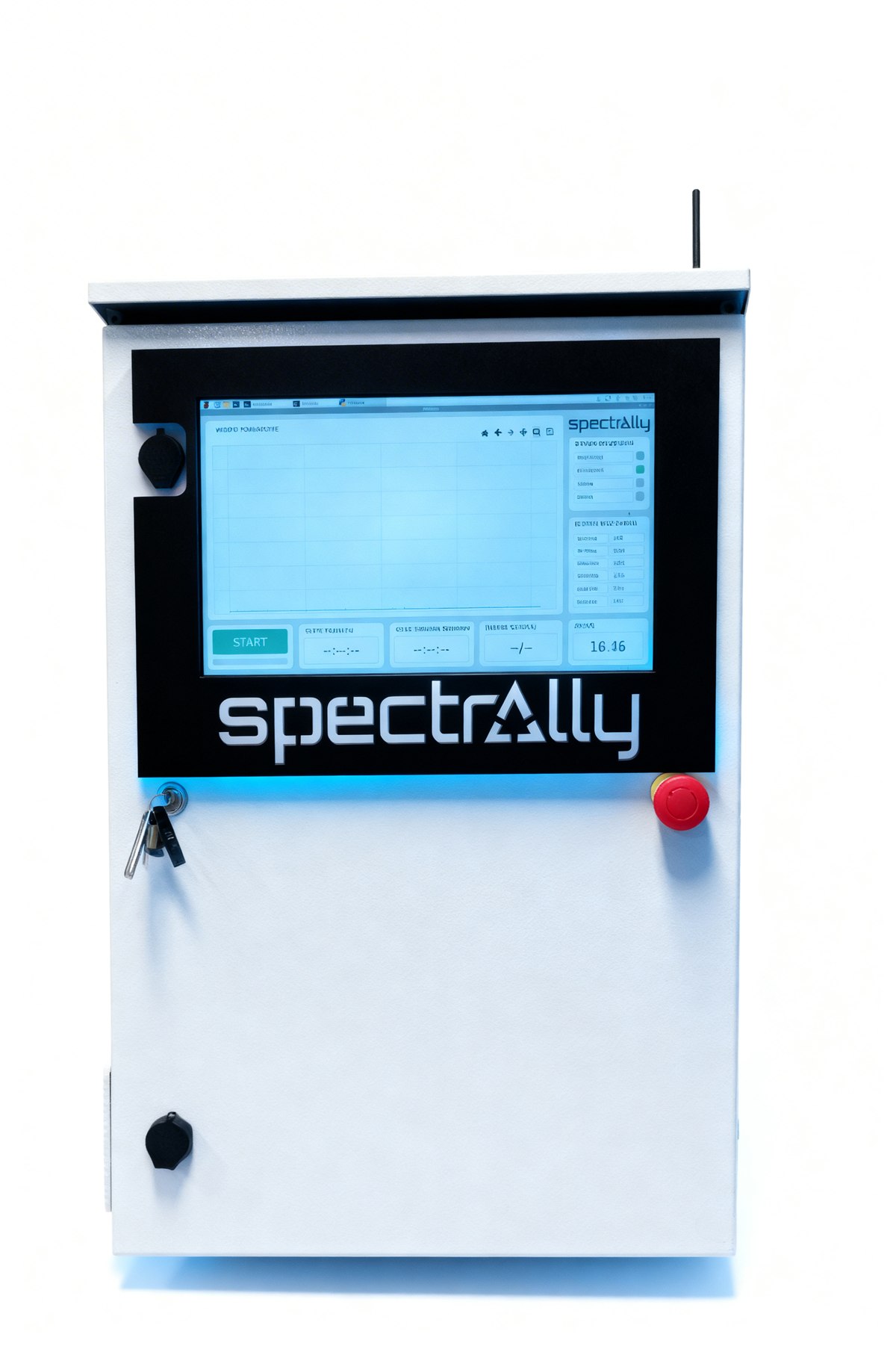
A process Raman analyzer for continuous service.
Spectrally X1 INLINE measures composition in the installation, continuously through the run. Two channels come as standard, enough for a reaction outlet and a storage tank from one cabinet.
| Measurement principle | Raman spectroscopy |
| Laser wavelength | 785 nm or 1064 nm (for strongly fluorescing media) |
| Spectral range | 300–1650 cm⁻¹ or 300–3500 cm⁻¹ |
| Spectral resolution | 8 cm⁻¹ |
| Acquisition time | 5–300 s |
| Detector | Back-thinned CCD, TEC-cooled |
| Measurement channels | Up to 2 as standard, more on request |
| Industrial protocol | Modbus |
| Calibration | Automatic, against a reference integrated in the probe |
| Laser lifetime | Min. 2 years |
| Operating conditions | 0–45 °C; 20–70% RH, non-condensing; warm-up 30 min |
| Power | 230 V AC, 50/60 Hz, grounded; 300 W |
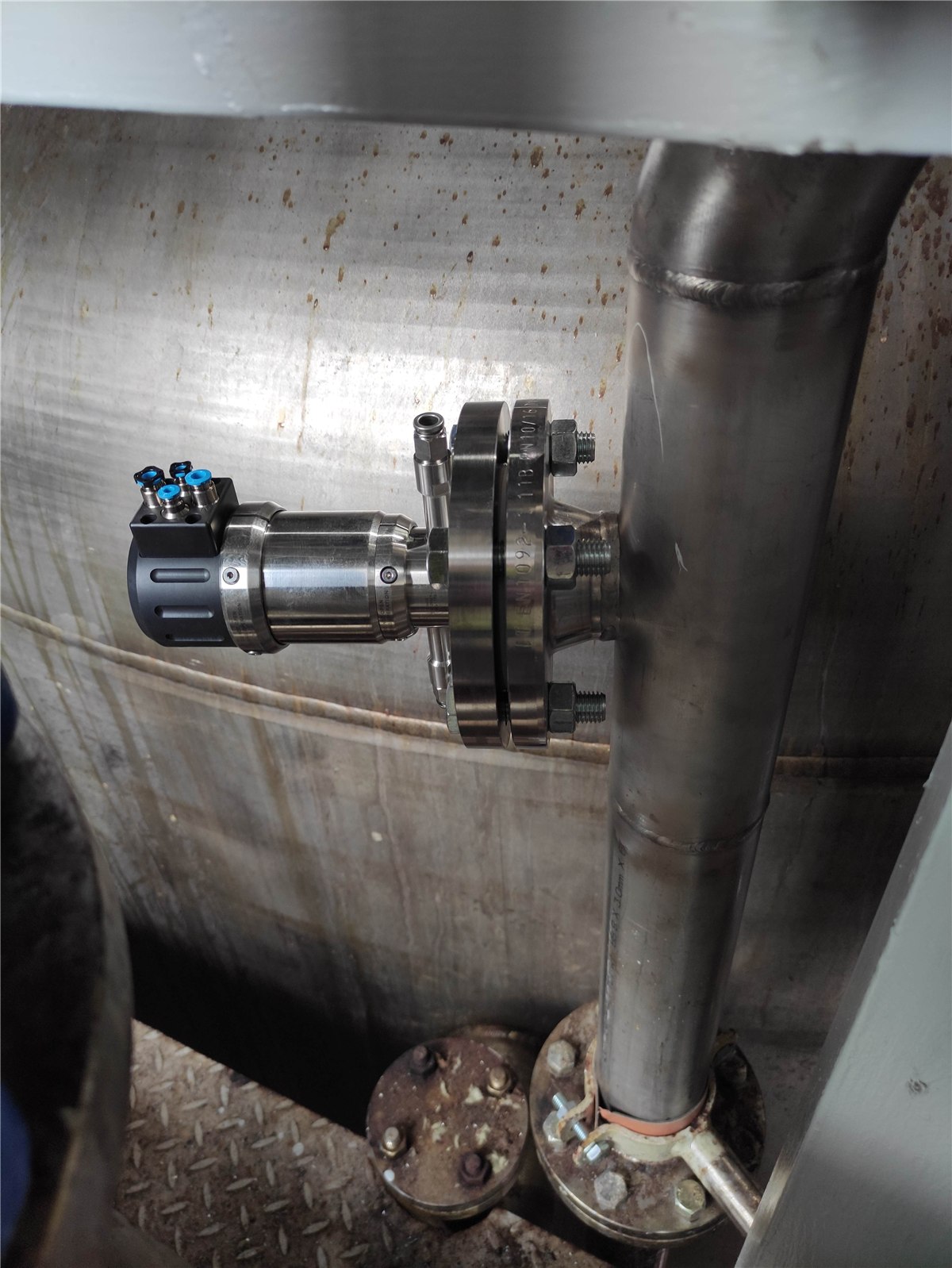
The part of the system that sits in your medium.
An immersion probe for liquids, suspensions and slurries in lines and tanks, in batch or continuous operation. The retractable self-cleaning module keeps the window clear while the analyzer stays in service.
| Probe type | Immersion, fiber-optic connection to the analyzer |
| Process pressure | Up to 16 bar |
| Process temperature | −40 to +125 °C |
| Process pH | 2–10 continuous; 1–14 short-term |
| Ingress protection | IP67 |
| Wetted materials | 316L stainless steel, fused-silica window, chemically resistant epoxy |
| Process connections | Flange DN32/40/50 PN16; ANSI 1¼″/1½″/2″ Class 150; NPT male 1¼″; Tri-Clamp 1½″ and 2″; custom design |
| Cleaning | Retractable self-cleaning module: automatic retract, rinse and return cycle |
From raw spectrum to a value your operators act on.
Spectrally OS turns spectra into thiosulfate, sulfate and homogeneity values, flags deviations against the grade specification and keeps the record on the analyzer.
| Predictive models | Hybrid of neural networks (CNN) and classical chemometrics (PLS, PCA) |
| Spectral database | Proprietary and public, approx. 28,000 spectra |
| Operator interface | SpectrallyUI, touchscreen |
| Data export | CSV / PDF / RAW |
| User management | Role-based access control (RBAC) |
| Data storage | Local database; measurement and logging continue without network |
| Industrial protocol | Modbus to PLC, DCS, MES, SCADA or LIMS |
Flags with the numbers
PASS/FAIL classification, anomaly detection and alarms against your grade specification, sent to the PLC or DCS.
A logged model lifecycle
Calibration, validation and maintenance: models start in the feasibility study, are retrained on your production data and re-calibrated when a recipe changes. Every change is logged.
One software layer, lab to line
Models move between Spectrally X1 LAB, X1 PORTABLE and X1 INLINE, so the model built during feasibility is the starting point for the line model, which is then retrained on your production data.
The differences are physical.
Four points that matter for an aqueous thiosulfate liquor, and two that stay with the lab.
The cations have no usable Raman band in water, so nitrogen, K₂O and magnesium stay on your lab method.
The certificate of analysis stays on your lab method. The inline reading tells the shift when a sample is worth taking.
Titration and ion chromatography remain the analytical reference methods. The accuracy for each liquor comes from the feasibility study on samples from that plant, measured against its lab methods.

Hope you find it interesting. Please contact us and talk about our analysis in detail.
a.lukasiewicz@gekkophotonics.com+1 804 593 0282