
Introduction
In the chemical industry, Raman spectroscopy is most commonly associated with thermoelectrically cooled back-thinned CCD arrays — a standard solution that provides a good signal-to-noise ratio in inline applications with 785 nm lasers and typical acquisition times of 5–300 s. In recent months, however, a different class of detectors has emerged in the literature: SPAD (single-photon avalanche diode) arrays in CMOS technology, with on-chip timing electronics, designed for time-resolved measurement.
We are monitoring the development of SPAD detectors as one of the key research threads for applications involving strongly fluorescent matrices — because it is in this area that classical CCD technology most quickly reaches its limits. Below is a brief overview: what SPAD technology realistically offers, what recent publications have confirmed, and where it makes sense to consider this approach in process measurements.
What is a SPAD and why is it appearing in Raman spectroscopy
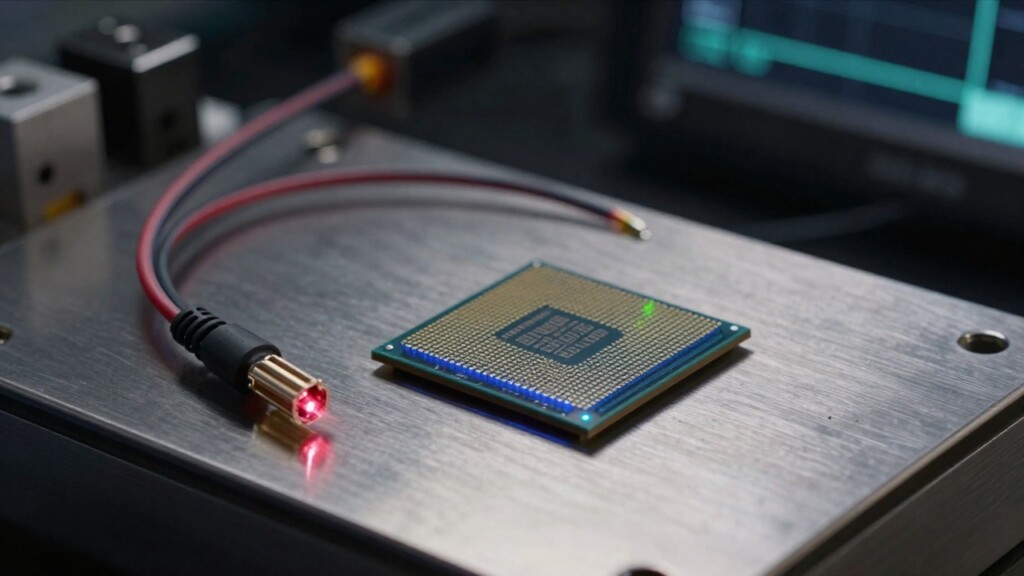
A SPAD is an avalanche diode operating above its breakdown voltage (in Geiger mode). A single photon triggers an avalanche, generating a digital pulse. Unlike a CCD array, which integrates charge over the exposure time, a SPAD registers individual photons with a timing accuracy on the order of hundreds of picoseconds.
Features relevant to Raman spectroscopy:
- Time gating below 1 ns — enables rejection of signals arriving later than Raman scattering
- No need for cryogenic cooling — dark noise increases with temperature, but SPAD modules typically operate near room temperature with moderate TEC
- Single-photon counting mode — sensitivity sufficient for very weak signals
- CMOS integration — enables miniaturization and placement of TDC (time-to-digital converter) electronics directly on the chip
Time-gated Raman — a key use case for SPAD
Raman scattering is a nearly instantaneous process (sub-picosecond), while fluorescence occurs on a nanosecond timescale. If the sample is excited by a short laser pulse and the detector is gated to a time window synchronized with the pulse (on the order of hundreds of ps), most fluorescence photons arrive at the detector after the window closes and are not counted.
This mechanism allows overcoming one of the fundamental limitations of classical CW Raman (with a continuous-wave laser): the fluorescence background, which can exceed the Raman signal by several orders of magnitude in samples such as crude oils, black polymers, liquid fuels, biomass, and certain phenol-formaldehyde resins.
In practice — alternatives to time-gating include excitation with a 1064 nm laser (shifting away from the fluorescence band) or mathematical background correction. Each of these paths has costs: 1064 nm requires InGaAs detectors and has a lower Raman cross-section (which scales with the fourth power of frequency), while background correction does not fully recover information when fluorescence saturates the detector.
What recent publications have confirmed
Several noteworthy papers have been published recently:
Heriot-Watt University, 2025 — the team published a paper titled „Time-resolved Raman spectroscopy using a CMOS SPAD array to remove fluorescent and fibre Raman backgrounds.” They used a 512-pixel linear CMOS SPAD array with on-chip timing electronics for Raman measurements with acquisition times on the order of 30 s. Notably for applications, time gating allowed them to remove not only the fluorescence background but also the parasitic Raman signal from the optical fiber delivering the laser to the sample. In inline configurations with fiber lengths of several tens of meters, the latter can be a real problem (source: PubMed 40677818, PMC12265467).
Light: Advanced Manufacturing, 2026 — the team proposed a Raman measurement in a Fourier scheme combined with a SPAD array and an interferometer. The architecture achieves a temporal resolution on the order of hundreds of ps while maintaining a wide spectral range. For Raman imaging applications with strong fluorescence backgrounds, this is a very promising direction (source: Light AM 2026, lam.2026.017).
Multipoint Raman with a CMOS SPAD array — in 2023, an architecture was proposed for measuring Raman spectra from multiple sample points using a single laser and a single spectrometer, leveraging the timing capability of the SPAD array to distinguish signals from different optical fibers of known lengths. For processes with multiple measurement points (pipelines, parallelized reactors), this is a promising path for equipment cost savings (source: IEEE Xplore, document 10105633).
MDPI Sensors, 2021 — the review „Single Photon Avalanche Diode Arrays for Time-Resolved Raman Spectroscopy” remains a good introduction to the topic for those wishing to orient themselves in the detector landscape (source: MDPI Sensors 2021, 21/13/4287).
What SPAD does not yet solve in process measurement
A few things must be honestly stated:
Commercial availability. Time-gated Raman with SPAD arrays currently remains primarily an academic domain and is commercialized by select vendors — in terms of inline-process-grade categories (IP65, ATEX, PROFIBUS/PROFINET integration, service certification, mean-time-between-failures for 24/7 operation), the ecosystem is significantly less mature than classical Raman with CCD.
Pulsed laser power. Time-gating requires a pulsed laser (typically picosecond) with sufficient energy per single pulse. This is a different cost component than the 600 mW CW laser used in classical process Raman. The average laser power may be comparable, but the peak power is higher — photochemical safety considerations for the sample require separate analysis.
SNR per unit time. For non-fluorescent samples, a classical CCD configuration with a CW laser can provide comparable or better SNR in a shorter time. SPAD provides an advantage when the classical measurement struggles with a fluorescence background.
Thermal stability and calibration. SPAD arrays have dark count characteristics dependent on temperature, and pixel-to-pixel uniformity requires careful calibration. This is feasible but requires engineering expertise.
Unit cost. CMOS SPAD detectors manufactured in foundry processes have the potential for cost reduction at scale — today, however, they are more expensive than back-thinned CCDs of comparable resolution.
Gekko Photonics solutions for process measurement today
At present, our process analyzers work with thermoelectrically cooled back-thinned CCD arrays and a 785 nm laser with 600 mW power. This architecture performs well for most applications for which we receive inquiries: phenol-formaldehyde and urea resins, polycondensations, RSM/AdBlue, polymerization liquids, surfactants in detergents. For challenging samples with moderate fluorescence backgrounds, proper chemometric model selection in the platform Spectrally OS provides acceptable accuracies without the need to switch to time-resolved detection.
Spectrally X1 INLINE with an immersion probe and the Retractex self-cleaning module is our standard configuration for continuous measurement in a reactor. Communication via PROFIBUS or PROFINET, with up to 100 m of optical fiber between the analyzer and the probe. For laboratory applications, we work with Spectrally X1 LAB — a 25-vial carousel, through-package analysis. Mobile raw material verification at the warehouse gate is performed with Spectrally X1 PORTABLE.
We monitor SPAD detectors in engineering watch mode — when an application appears in our portfolio for which time-gating is the only sensible path (strongly fluorescent matrices where neither 1064 nm nor mathematical background correction suffice), we will introduce this variant in a controlled manner: a study on customer samples, model validation, and only then a hardware offer.
Test measurement and engineering consultation
If you know that your sample is strongly fluorescent and classical approaches (1064 nm laser, background correction, preliminary photobleaching) fail — let's talk. At Gekko Photonics, we select the analyzer configuration for the specific process chemistry, not the other way around. The meeting format is a 30-minute conversation with an application engineer, during which we discuss the sample, expected concentration ranges, installation conditions, and operational constraints. If the conclusion from the conversation is that it is worth testing your medium in the laboratory — we perform a test measurement, typically within 2 weeks of sample delivery.
Contact us — in the first step, we will ask about the specifics of the process; in the second, we schedule a conversation with the appropriate application engineer; and in the third — if it makes sense — we proceed to a test measurement.
Related reading: process Raman analyzers in our offer, Raman spectroscopy news — lasers and detectors 2026.
Frequently asked questions
Will SPAD detectors replace CCD arrays in process measurement? Briefly: not in the coming years as a universal alternative. SPAD makes sense where fluorescence actually blocks the measurement — in that case, time-gating is the only sensible path. For most process applications (resins, cosmetics, fertilizers, polymers, fuels with sensible laser selection), cooled CCD remains the solution with a better cost/result ratio per unit time.
How does SPAD differ from EMCCD or ICCD in the context of Raman? EMCCD amplifies charge within the array itself (impact ionization) — it offers an advantage for very weak continuous signals but does not allow sub-nanosecond gating. ICCD has an intensifier with a photocathode and allows ns gating — historically used in time-gated Raman, but it is costly, fragile, and has lower quantum efficiency than back-thinned CCD. CMOS SPAD provides sub-ns gating with lower electronics cost, lower power consumption, and scaling potential.
Can SPAD help with Raman measurements of crude oils (downstream petrochemistry)?)? Potentially yes — crude oils are a classic case of strong fluorescence background. In process practice, alternatives include a 1064 nm laser with an InGaAs detector or Raman SERS (surface-enhanced). The choice of path depends on analyte concentrations, acceptable accuracy, and application requirements.
What does Gekko Photonics offer in the area of time-resolved detection? In the current offering of Spectrally X1 analyzers, we use back-thinned CCD detectors with a 785 nm CW laser. SPAD detectors and time-gated Raman are treated as technology under observation — when a client’s portfolio includes an application for which time-gating is the only viable approach, we proceed with a feasibility-first approach: study on samples, validation, and only then an offer.
Can I count on a SPAD configuration for a specific application as early as today? For selected R&D projects in pilot mode — possible after a prior feasibility study. This is not our default catalog offering, but if the application genuinely requires it, we are capable of designing such a path. Contact us — we discuss each such topic on an individual basis.