
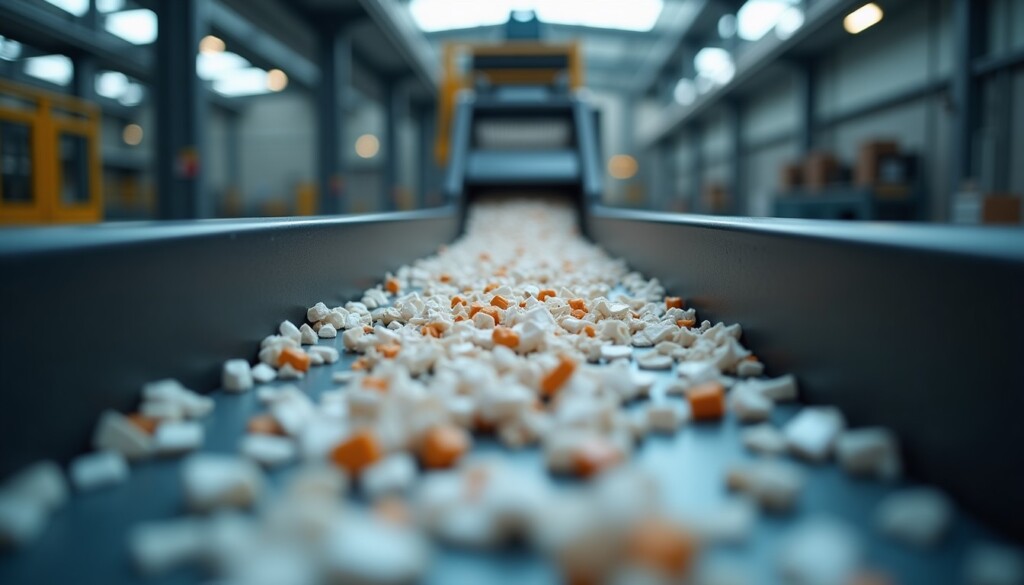
In 2026, plastic sorting facilities face a problem known to every modern recycling plant — the polymer waste stream is becoming increasingly heterogeneous, and classical NIR methods have reached their limits. This applies especially to carbon black-pigmented plastics and mixed fractions from waste electrical and electronic equipment (WEEE), where selective differentiation of PE, PP, PET, PS, ABS, and copolymers requires techniques with higher chemical specificity.
Recycling polymers is not our core business — most of our implementations are in resins, cosmetics i fertilizers, — but our platform Spectrally X1 INLINE, LAB i PORTABLE already has documented feasibility in this area: quantitative determination of silicone contaminants in PA66 recyclate (calibration 0.3–1.0%) and differentiation of contaminants in LDPE/HDPE recyclates. Each new sorting application is confirmed through design, following feasibility testing on client samples. This review organizes the landscape of spectroscopic techniques for polymer recycling in light of 2025–2026 publications.
The stakes are high: meeting European regulatory targets for single-use plastics and the new Packaging and Packaging Waste Regulation (PPWR), as well as the market requirements for rPET, rPE, and rPP, are driving increasingly higher purity demands for output fractions. Spectroscopy is the tool here — the choice of a specific technique (Raman, NIR, MIR, MWIR, THz) depends on the chemistry of the stream and the material class requirements.
Why classical NIR reaches its limits in a modern sorting plant
Near-infrared hyperspectral imaging (NIR-HSI, typically 0.9–1.7 µm) is today the standard in large second and third-generation sorting plants. Identification of typical packaging fractions — PET, HDPE, LDPE, PP — works stably, given proper material presentation on the belt and a well-chosen measurement geometry with the illuminator. The problem begins where carbon black appears as a pigment: strong absorption in the NIR causes reflectance to be near zero, leaving the classifier with no signal to process.
A second area difficult for NIR is WEEE mixtures — electronics housings most often contain ABS, HIPS, PC, and PC/ABS blends, frequently black, with flame retardant additives. Here, increased selectivity requires transitioning to a technique with higher chemical specificity — Raman, MIR, MWIR-HSI, or THz-TDS — or using a hybrid NIR system with an additional spectral channel.
Deep-UV Raman for black plastics — progress in 2026
One of the most interesting results of 2026 is a published Journal of Raman Spectroscopy solution utilizing deep ultraviolet Raman (DUV, NeCu laser at 248.6 nm) for identifying black plastics directly on a sorting belt. The key point is that fluorescence emission from black additives occurs in the near-UV and visible range — i.e., outside the Raman spectral range excited by DUV. Consequently, the Raman signal is not suppressed by background, even though the dominant pigment is carbon black.
The authors demonstrated differentiation of PE, PP, and PET — the commercially most important classes — from a stand-off distance suitable for conveyor geometry. This represents a significant capability increase compared to a typical NIR-HSI setup, which would fail completely for the same materials in their black variant. Limitations of the current demonstration include the cost and serviceability of the DUV laser and optical safety requirements — in a production sorting plant environment, the solution remains in the demonstrator phase.
Raman with machine learning in WEEE sorting
A second line of recent publications combines classical Raman at 785 nm and 1064 nm with machine learning models — Discriminant Analysis (DA) and Support Vector Machine (SVM) — for WEEE fractions. Goal: separation of PS, ABS, PC, and PC/ABS blends in the presence of pigments and flame retardants. The longer wavelength (1064 nm) effectively reduces fluorescence typical of flame retardant additives and dyes, at the cost of a slightly lower Raman cross-section — a well-known compromise in process spectroscopy.
This compromise between 785 nm and 1064 nm is familiar to every configuration decision for a process analyzer — we discuss it more broadly in our review of Raman wavelength selection. In the reality of a WEEE sorting plant, the choice of 1064 nm typically wins wherever fluorescence dominates the signal.
GAN networks and data augmentation — when reference spectra are insufficient
A third important publication from 2026 (Analyst, RSC) addresses a real implementation limitation: for many recyclate classes, the number of available reference spectra is small and imbalanced. The authors propose using generative adversarial networks (GANs) for spectral augmentation — the model learns the distribution of real spectra and generates synthetic samples that improve classifier stability on minority classes.
This direction is particularly significant for plants implementing classification „from scratch” — where the spectral library is built from internal samples rather than from ready-made reference sets. From an engineering perspective, GANs do not replace a good sampling protocol, but they allow starting operations with a smaller database and progressively expanding it.
Hyperspectral MWIR imaging as a complement
Beyond the Raman path, a second track is developing — MWIR-HSI (3–5 µm). Here, the problem of carbon black absorption does not exist, because in the mid-infrared, transmission and reflection depend on the vibrations of the polymer chain backbone, not on external color. Independent implementations from 2025–2026 report black ABS separation purity approaching 99% with appropriate camera geometry. Limitations include the cost of the MWIR detector (typically cryogenically cooled InSb or MCT) and the need for thermal calibration.
In practice, mature sorting plants in 2026 are increasingly building multi-channel architectures: NIR-HSI as the first line, MWIR-HSI or Raman as a second decision path for fractions that NIR did not classify with sufficient confidence. We know the same thinking from process analytics in chemistry: modern detectors and multi-channel measurement architectures allow achieving a compromise between cost, speed, and selectivity that a single technique cannot attain.
Spectrally X1 — adaptation possibilities for polymer recycling
We have the most implementations in process chemistry — phenolic and urea-formaldehyde resins, cosmetics, fertilizers, adhesives, and hydrocarbons. In polymer recycling, we enter on a project basis: we check in a feasibility cycle on client samples whether the Raman configuration is the right method for a given stream and analytes, before the client commits CAPEX. What specifically do we offer for adaptation in this path?
- Spectrally X1 LAB — a stationary analyzer for calibration work and building spectral libraries from samples taken from the line. With a carousel for up to 25 vials and through-package analysis, it accelerates the feasibility and chemometric model validation phase before inline implementation.
- Spectrally X1 PORTABLE — a portable analyzer for mobile verification of output fractions from the sorting plant, IQC audits at regranulate suppliers, and reference measurements in the field. With an SNR of 547 and a standalone touchscreen mode, it enables PASS/FAIL decisions without connecting a PC.
- Spectrally X1 INLINE — in selected control applications downstream of the sorting plant (e.g., monitoring regranulate quality at the extruder outlet), an immersion probe and communication via PROFIBUS/PROFINET allow integration of the measurement with the host system.
- Spectrally OS — a common software layer for the entire X1 family, with a database of ~28,000 spectra and CNN/PLS/PCA models. For recycling, model drift monitoring is particularly important, as stream composition changes seasonally.
What Spectrally X1 is not: it is not a hyperspectral sorter with an NIR or DUV camera. It is a point Raman analyzer designed for chemical analytics — and that is its role in the recycling architecture. Hyperspectral cameras on the sorting belt are a separate equipment category from independent suppliers; we enter where the chemical selectivity of Raman is needed (copolymer speciation, additive control, regranulate batch verification).
FAQ — frequently asked questions
Will Raman replace NIR-HSI in the sorting plant?
No. NIR-HSI remains the first-choice technique for typical packaging fractions (PET, HDPE, LDPE, PP) — it is fast, low cost per measurement, and imaging-based. Raman enters where NIR fails: black plastics, WEEE fractions, copolymer speciation, verification of regranulate for additives. The sorting plant architecture in 2026 increasingly combines both techniques in a cascade.
Is 785 nm sufficient for recycling, or is 1064 nm needed?
For clean engineering polymers, 785 nm is usually sufficient. For plastics with dyes and flame retardants (WEEE, hard black material), 1064 nm significantly reduces fluorescence and improves classifier quality — at the cost of a lower Raman cross-section. The decision is made based on samples.
How many reference spectra are needed to start a classifier?
It depends on the number of classes and their spectral similarity. For 4–6 packaging classes, typically a few hundred spectra per class with good variation in geometry and environmental influence are sufficient. For WEEE with blends and dyes, this number increases many times over — and here augmentation techniques (GANs, perturbations, spectral jittering) are helpful.
Does Gekko Photonics have implementations in polymer recycling?
Most of our implementations are in process chemistry — resins, cosmetics, fertilizers, adhesives, and hydrocarbons. In polymer recycling, we engage on a project basis: we start with a feasibility study on client samples, verify whether Raman is the appropriate method for the given analyte and matrix, and only then propose the X1 LAB / PORTABLE / INLINE configuration and model. Spectrally OS.
How long does a typical feasibility study on recyclate samples take?
Typically 2–4 weeks from receipt of a representative set of samples (reference-classified). The result is a report with an assessment of class separability, a proposal for wavelength, acquisition time, and a preliminary chemometric model for further validation.
Test measurement and engineering consultation
At Gekko Photonics, we start with a conversation with an application engineer — a 30-minute meeting where we discuss the typical composition of your stream, the material classes you want to differentiate, and the KPI requirements for your sorting plant or regranulate control. We perform a test measurement on your samples, typically within 2 weeks of receiving them. We invite you to contact us — we will respond with specifics, including a test number and an indicative budget, instead of a vague offer. You will find the full list of our process analyzers in a separate section.
Sources
- Zada L. et al., Black Plastic Identification for Sorting and Recycling With Deep-UV Raman Spectroscopy, Journal of Raman Spectroscopy 2026 (Wiley): analyticalsciencejournals.onlinelibrary.wiley.com
- Raman spectroscopy integrated with machine learning techniques to improve industrial sorting of WEEE plastics, ScienceDirect / J. Environmental Management 2025: sciencedirect.com
- Classification of recycled plastics using sparse and imbalanced spectral data and data augmentation by GAN, Analyst (RSC) 2026: pubs.rsc.org
- New Raman Spectroscopy Breakthrough Boosts E-Waste Plastic Recycling Efficiency, Spectroscopy Online: spectroscopyonline.com