Surfactants and glycerin determine the quality of most cosmetic and detergent formulations — from shower gels and shampoos to laundry concentrates. The concentration of active SLES (sodium laureth sulfate), glycerin content, and the proportions of water and alcohol directly affect viscosity, clarity, emulsion stability, and sensory comfort of the product. Meanwhile, laboratory reference methods — titration, HPLC, refractometry — are slow, disconnected from the process, and prone to sampling delays.
At Gekko Photonics, we design and manufacture process Raman analyzers in Poland — in inline, laboratory, and portable variants — and implement them, among others, in the production cosmetics, of cosmetics and detergents. In this article, we demonstrate how inline monitoring of SLES and glycerin in a mixer or reactor shortens the production cycle, stabilizes quality, and reduces waste. We maintain an engineering-level approach: which probe to install where, what to expect from the spectrum, and how to build a chemometric model.
Why SLES and glycerin are problematic for classical analytics
SLES is an anionic surfactant with a variable number of oxyethylene groups (typically 1–3 EO), produced in commercial pastes usually at 28% or 70% dry matter. Glycerin acts as a humectant at concentrations of 1–10%, sometimes higher. Both components dissolve well in water but form viscous, sometimes gelling systems, where manual sampling disrupts the phase and delays decisions on recipe adjustments.
Difficulties of classical analytics:
- Titration of anionic surfactants (e.g., hyamine method) takes several tens of minutes per sample and requires dilutions that can themselves distort the result for high-dry-matter pastes.
- Refractometry provides a total signal — it does not distinguish SLES from glycerin or other humectants, so raw material batch variability passes into the product undetected.
- HPLC and NMR are accurate but impractical on the production line and are typically performed post-factum in QC.
As a result, the production team either waits for the lab (line downtime) or blocks the batch „just in case,” generating rework or losses.
What is visible in the Raman spectrum — SLES, glycerin, and water
Raman spectroscopy measures inelastic scattering of laser light on chemical bond vibrations. In the so-called fingerprint range (typically 300–1650 cm⁻¹), we see characteristic, sharp bands that allow simultaneous identification and quantitative determination of key formulation components:
- SLES shows distinct stretching bands of the sulfate group around 1050–1100 cm⁻¹ and carbon-oxygen bands from the oxyethylene chain — in a region where the water matrix is relatively quiet.
- Glycerin has a recognizable set of C–C and C–O skeletal bands around 850–1050 cm⁻¹, including a band used as a quantitative indicator in water-glycerol mixtures.
- Water in the fingerprint range is a weak scatterer, which significantly simplifies calibration models compared to, e.g., NIR, where the water absorption band dominates the entire spectrum.
For typical cosmetic/detergent production, this means that with a single measurement lasting seconds, we obtain information on multiple critical components — without sampling, reagent chemistry, or line stoppage.
Inline configuration — where to install the probe
Natural measurement points in a typical cosmetic/detergent line:
- SLES raw material inlet — probe in the pipeline between the buffer tank and the main mixer. Purpose: verification of raw material dry matter and detection of variability between supplier batches before they enter the recipe.
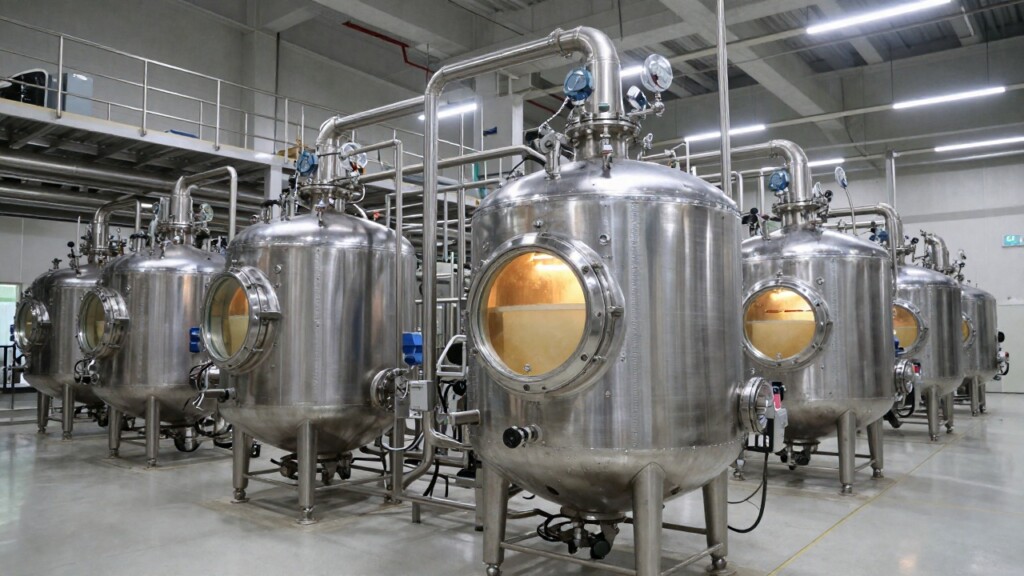
- Main mixer (mixer/reactor) — immersion probe in a side port of the mixer. Purpose: tracking homogenization, neutralization, and achieving target SLES/glycerin concentration after dosing.
- Transfer line to product tank — confirmation measurement that the finished formulation meets parameters before being sent to storage.
The immersion probe typically operates via a threaded process connection (NPT or DN) with a seal selected according to the medium. For viscous and foaming media, such as surfactant concentrates, the optical window of the probe and the cleaning strategy are important — both mechanical (Spectrally X1 PROBE with self-cleaning Retractex component) and process-related (CIP cycles between batches).
Chemometrics — from spectrum to number
A raw spectrum is a plot of intensity vs. wavenumber. To obtain numerical concentrations of SLES or glycerin, a chemometric model is needed. Typical workflow:
- Collection of calibration set: 30–80 samples covering the real working range (e.g., SLES 5–35% dry matter, glycerin 1–10%) with reference values from the laboratory.
- Preprocessing: removal of fluorescence background (baseline correction), normalization, optionally SNV — here, repeatability matters, not algorithmic combinatorics.
- PLS model (Partial Least Squares) or CNN for more complex mixtures, validated by cross-validation. Raman models for water-surfactant systems typically yield RMSECV on the order of fractions of a percent for calibration ranges of 1–10%, but specific numbers depend on calibration quality and probe measurement repeatability.
- Validation in production: several weeks of operation in shadow mode with reference measurements, monitoring model drift.
Chemometric models — PLS, PCA, CNN — operate in our platform Spectrally OS, common to the entire X1 analyzer family. The same software layer handles spectrum acquisition, calibration, alarms, and archiving, regardless of whether the probe works in a mixer or the spectrum is collected by a laboratory analyzer.
Business value — what production gains
Implementing inline measurement on a cosmetic/detergent line changes the process economics in several areas simultaneously:
- Shorter batch cycle — elimination of waiting for lab results allows real-time production decisions. In process industry, this typically reduces cycle time by around a dozen percent.
- Fewer reworks — early detection of composition deviations (e.g., SLES batch out of specification) allows recipe correction before feeding into the product tank, instead of collecting a 5-ton non-spec batch.
- Scale-up stability — when implementing a new formulation, inline measurement in the R&D mixer and the same probe in production facilitates technology transfer. In one cosmetic implementation, we speak of savings on the order of EUR 100,000 per year resulting precisely from better emulsion scale-up control.
- Reduction of laboratory workload — the QC lab performs spot checks and model validations instead of full procedure for every batch. This often means a reduction in analytical costs by several tens of percent.
The average ROI for inline Raman implementations in process chemistry that we have carried out falls within 6–10 months. Implementation time from feasibility workshop to a working system in production is typically 3–5.5 months.
Gekko Photonics solutions for SLES and glycerin monitoring
Our Spectrally X1 analyzer family was built with the idea that the same Raman measurement — with the same 785 nm laser, the same 300–1650 cm⁻¹ range, and the same chemometric layer — should be available at every stage of the process:
- Spectrally X1 INLINE — process Raman analyzer with an immersion probe mounted directly in the mixer or pipeline. Operates 24/7, communicates with DCS via PROFIBUS/PROFINET, supports fiber optics up to 100 m. For viscous and foaming media, we offer the self-cleaning Retractex probe module.
- Spectrally X1 LAB — benchtop analyzer for calibration work in QC and R&D laboratories. Supports a 25-sample carousel, measures through transparent packaging (through-package), ideal for building calibration sets and validating models before inline deployment.
- Spectrally X1 PORTABLE — portable analyzer in a suitcase for incoming QC at the warehouse gate (verification of SLES batches from suppliers) and mobile reference measurements on the production floor.
- Spectrally OS — common chemometric platform (PLS, PCA, CNN) with a library of ~28,000 spectra, alarms, dashboards, and archiving.
The entire family operates under a single workflow — a model built in the laboratory on the X1 LAB transfers to the X1 INLINE without rewriting the calibration from scratch. This is important when a cosmetic formulation moves from R&D through pilot to full production.
Industry context and typical deployment scenarios in cosmetic and detergent production are described in more detail on the page cosmetics and detergents industry. A full overview of inline architectures and criteria for topology selection (single probe vs. multi-probe analyzer, location, DCS integration) can be found in our article Inline process analyzers — types, architectures, and selection. The list of all analyzers is collected under /analyzers/.
FAQ — frequently asked questions
Can Raman measure SLES with low dry matter content (below 51%) in finished shower gel?
Yes, within the typical range of 1–10% active SLES formulations, the signal from sulfate bands is well measurable, provided a chemometric model is built on samples from the real range. Lower concentrations require extended acquisition time and well-prepared calibration.
Is a self-cleaning probe necessary for surfactant concentrates?
Often yes — SLES concentrates above 50% dry matter are viscous and may deposit a film on the probe window. In such applications, the Retractex module (probe retraction, rinsing, return to process) noticeably extends model stability between service cycles. For diluted formulations (below 20% dry matter), a standard immersion probe is typically sufficient.
How long does it take to build a chemometric model for a new formulation?
For the SLES + glycerin + water system — typically 4–8 weeks from the first sample collection to a validated, operational model. From our experience, the biggest variable is access to representative samples covering the full working range, not the computation time itself.
Does Gekko Photonics implement measurements in an existing, operating cosmetics line?
Yes. We typically start with a feasibility workshop on client samples (usually 2–4 weeks), then a pilot measurement on the line in shadow mode with a laboratory model, followed by full implementation with DCS integration. The entire cycle from workshop to production operation is typically 3–5.5 months.
Is the measurement destructive — what about product hygiene?
No. Raman spectroscopy is a non-contact optical method — the laser illuminates the sample through the probe window; the sample is neither extracted nor modified. This meets product hygiene requirements in cosmetics (sanitary-grade probe, chemically resistant materials).
Test measurement and engineering consultation
If you are working on a formulation with SLES, glycerin, or another mixture of surfactants and humectants — let's talk. At Gekko Photonics, we select the probe configuration, acquisition lengths, and chemometric model for the specific recipe and process topology. Standard pathway:
- A 30-minute conversation with an application engineer — process review, samples, expected ranges. We determine whether it is worth proceeding.
- Test measurement on client samples in our laboratory — within 2 weeks of receiving samples, we deliver a spectral report and preliminary feasibility assessment.
- Feasibility study and configuration proposal (X1 INLINE / LAB / PORTABLE, probe, model) with an implementation timeline.
Write to us via contact form — briefly about the process and analytes; we will handle the rest.