
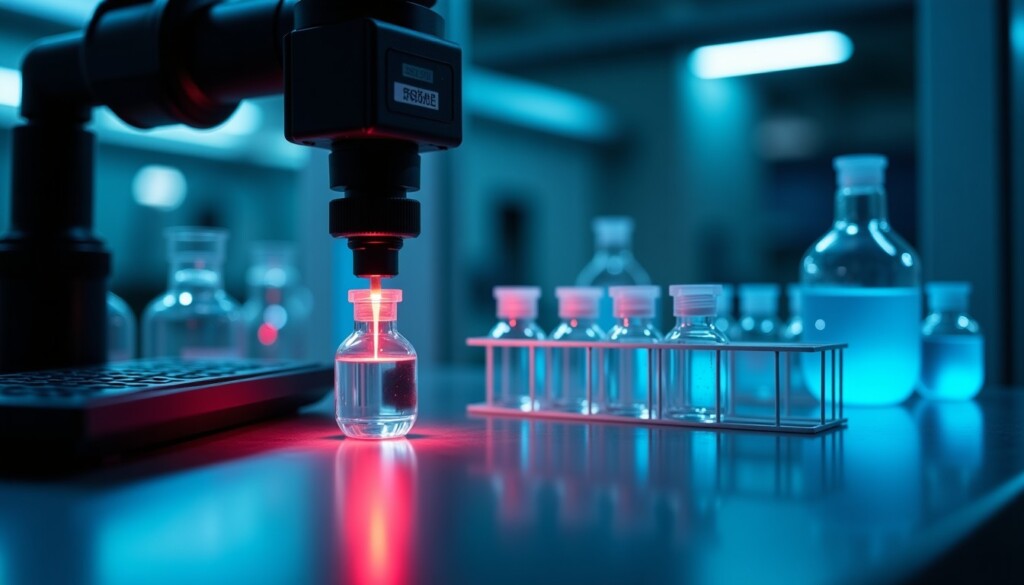
SERS (Surface-Enhanced Raman Scattering) entered 2026 as one of the fastest-growing branches of Raman spectroscopy — with an emphasis on flexible plasmonic substrates, integration with deep learning models, and the first implementations in drug therapy. We view this as a manufacturer of Raman analyzers, whose foundation is process chemistry — phenol-formaldehyde resins, cosmetics, fertilizers, hydrocarbons. We enter the pharmaceutical sector on a project basis: on client samples, we verify in a feasibility cycle whether Raman or SERS is the appropriate method for a given analyte and matrix, before the client commits CAPEX. Below, we compile the most significant recent publications from the past few weeks.
How SERS Differs from Classical Raman
Classical Raman measurement relies on inelastic scattering of photons by molecular vibrations. The signal is weak — typically one Raman photon per 10⁶–10⁸ excitation photons. This suffices when the analyte is at percentage concentrations (e.g., free formaldehyde in resin, urea in fertilizer), but becomes limiting for trace substances — drug metabolites, post-reaction impurities, drugs in serum.
SERS utilizes electromagnetic field enhancement near metallic nanostructures (most commonly Au, Ag) — in so-called. hot spots the Raman signal increases by orders of magnitude (literature reports up to 10⁶–10⁸×, though in real analytical applications more often 10³–10⁵×). This enables detection at nanomolar and picomolar concentrations — opening a window where Raman begins to compete with LC-MS in specific screening and monitoring tasks.
2026 Developments — Flexible SERS Substrates
The year 2025 and the first half of 2026 were dominated by work on flexible SERS substrates. This is because rigid silicon or glass substrates work well in the laboratory but are impractical in industrial conditions — they do not wrap around irregular surfaces, break easily, and are costly per measurement.
Recent publications include, among others:
- PVDF membranes grafted with Au–Ag alloy and carbon nanotubes — with a declared detection limit on the order of 10⁻¹¹ M and RSD below 10%. The substrate is flexible and can be used to wrap samples of irregular shape.
- SERS patches based on Ag nanostructures — a concept akin to „adhesive tape” for collecting analyte traces from surfaces and measuring ex situ.
- Wearable substrates with porous HOF (Hydrogen-Bonded Organic Frameworks) scaffolds and Au nanoplates — a concept for detecting residues of cytostatic drugs on work surfaces and packaging.
- Polyamide fabrics with deposited silver as reusable substrates for trace contaminants — a direction driven by rising nanofabrication costs.
The common denominator is an attempt to move from the laboratory to a „field-ready” level — with the possibility of integration with a portable Raman spectrometer.
SERS Plus Deep Learning — A Breakthrough in Spectral Interpretation
The second growth area is the integration of SERS with deep learning models. The reason is practical: a SERS spectrum carries a vast amount of molecular information but is also exceptionally susceptible to fluctuations caused by hot spot geometry, molecular orientation relative to the surface, temperature drift, and matrix properties. Classical chemometrics (PLS, PCR) works but has its limits with highly noisy spectra or classification of closely related molecules.
Recent work demonstrates, among others:
- Deep Learning-Assisted SERS for Monitoring Clozapine in Serum (Nano Letters, 2025) — a CNN network trained on spectra from plasmonic metasurfaces enables quantitative determination of an antipsychotic drug in serum, within a range relevant for therapeutic drug monitoring.
- Rapid Identification of Drug Mechanisms (ACS Sensors, 2025) — multichannel SERS plus CNN differentiates mechanisms of action of chemotherapeutics, including structurally similar drug classes.
- „SERSome” System” (Spectroscopy Online, 2025) — combines SERS with AI for identifying medicinal food ingredients, with a declared classification accuracy of 98% under minimal supervision.
This direction is changing the economics of the method — SERS, previously treated as a laboratory technique with high inter-measurement variability, is beginning to stabilize thanks to machine learning, which can extract a reproducible quantitative signal from an imperfect spectrum.
Therapeutic Drug Monitoring — The First Real Use Case Beyond Screening
SERS for TDM (Therapeutic Drug Monitoring) is the area most advanced toward clinical implementation. A review in the journal Molecules (MDPI, 2025) summarizes the current state: high sensitivity, non-destructive sample analysis, characteristic fingerprint spectra — all of this makes SERS an attractive alternative to HPLC for narrow-therapeutic-range monitoring (immunosuppressants, antiepileptic drugs, antibiotics with a narrow therapeutic window).
What Stands in the Way of Routine Implementation:
- Substrate Standardization — batch-to-batch differences in nanostructure geometry cause variation in enhancement, which must be compensated algorithmically or via an internal standard.
- Biological Matrices — serum proteins adsorb onto the Au/Ag surface and compete for active sites; solutions include separation membranes, surface functionalization, and microfluidic separation plates.
- Regulatory Validation — pharmacopoeia requirements for quantitative methods in TDM (repeatability, linearity, recovery, limit of quantitation) are demanding; SERS must meet these just as chromatography does.
Substrate Standardization — A Hot Topic in 2026
A market report from early 2026 states that over 40% of SERS substrate manufacturers report challenges in scaling production while maintaining batch-to-batch uniformity. This remains a barrier between „works in one laboratory” and „works everywhere the same.” Growing directions include:
- Paper and polymer substrates — cheaper, disposable, with better RSD than expensive reusable silicon substrates in certain applications.
- Internal standards (deuterated analogs, isotopically labeled references) — compensate for enhancement variation between measurements.
- Validation procedures based on spectral consistency tests — something that Spectrally OS in our product family is routinely implemented for classical PLS/PCA models, but for SERS is only now being developed.
Spectrally X1 — Adaptation Capabilities for SERS and Pharmaceutical Research
At Gekko Photonics, we built our Raman product family around the chemical industry, but the optical architecture and software are sufficiently universal that adaptation to a specific SERS task is possible after feasibility testing on client samples.
- Spectrally X1 PORTABLE — a portable Raman analyzer with a 785 nm laser at 600 mW (alternatively, 1064 nm at 800 mW as a catalog option). Built-in touchscreen, IP54. A natural platform for research work with flexible SERS substrates at a warehouse gate or in a QC laboratory for rapid screening of raw materials or finished formulations.
- Spectrally X1 LAB — a benchtop analyzer with a carousel for up to 25 samples, through-package analysis, optional external probe. The LAB+ variant includes a library of approximately 28,000 reference spectra. It is suitable for calibration work, chemometric model validation, and SERS methodology studies in laboratory conditions — where we seek not a one-time result but a stable workflow before transitioning to inline.
- Spectrally X1 INLINE — a process analyzer with an immersion probe, PROFIBUS/PROFINET, and a Retractex self-cleaning module for challenging matrix variants. SERS in inline mode remains a challenge (plasmonic substrates degrade in process environments), but for selected applications — measurement of trace contaminants in post-reaction streams — this direction is entering design considerations.
- Spectrally OS — a common software layer (Debian GNU/Linux 13.2, PLS/PCA/CNN models, CSV/PDF/RAW export, RBAC, audit trail) supporting the entire X1 family. This is where we embed chemometric models and, project-wise, CNN networks trained for SERS spectral interpretation after feasibility.
Realistically: a full-value SERS implementation in pharmaceuticals requires a dedicated project involving the client's R&D team, the plasmonic substrate supplier, and us — as the spectrometer, software, and integration provider. We do not sell this off the shelf.
Full List of Process Analyzers in Our Offering shows where our center of gravity currently lies — process chemistry, cosmetics, fertilizers, wastewater. Pharmaceuticals is an area open for project discussion. For context, we also recommend our earlier review of Raman Spectroscopy in Bioprocesses (2025–2026) and the material on machine learning in process chemometrics.
FAQ — most frequently asked questions about SERS
Will SERS replace classical Raman in process analysis?
No. Classical Raman is stable, deterministic, easily validated, and handles analytes at concentrations from a fraction of a percent upward — i.e., within the typical process application window. SERS comes into play where classical Raman lacks sensitivity — particularly in trace analysis (TDM, micropollutants, contraband screening). These are complementary techniques, not competitive ones.
Why are flexible SERS substrates so important?
Because they open the door to measurements in situ on irregularly shaped surfaces — drug packaging, blisters, pharmaceutical forms, laboratory equipment. Rigid silicon substrates required sample preparation; flexible ones allow measurement where the sample is. This is a paradigm shift similar to the one Raman underwent over a decade ago, moving from the laboratory to continuous processes.
Are AI and deep learning essential for interpreting SERS spectra?
Not always. For single analytes and simple matrices, a well-prepared PLS or PCA suffices. AI becomes necessary when classifying structurally similar compounds, when substrate geometry varies between measurements, or when distinguishing signals with overlapping bands. The 2025 trend is not „AI everywhere,” but „AI where classical chemometrics chokes.”.
Does Gekko Photonics implement SERS in pharmaceuticals?
Most of our implementations are in process chemistry — resins, cosmetics, fertilizers, adhesives, hydrocarbons. In pharmaceuticals, we enter in a project-based mode, starting with feasibility on client samples. We verify whether Raman or SERS is the appropriate method for a given analyte and matrix, assess signal stability, and propose hardware configuration and chemometric model. If feasibility is positive, we proceed to the implementation project.
Which Gekko equipment is best suited for initial SERS trials?
From our family — Spectrally X1 PORTABLE for mobile tests on flexible substrates and screening, Spectrally X1 LAB (especially LAB+ with a library of 28,000 spectra) for calibration work in the laboratory. The selection of a specific configuration (wavelength — 785 or 1064 nm, measurement geometry, external probe) is determined after task analysis.
Test measurement and engineering consultation
If you are considering SERS for your pharmaceutical, biopharmaceutical, or analytical application — we suggest starting with two steps:
- 30-minute conversation with our application engineer — we describe the task, select the appropriate spectrometer model and test measurement format. Format: videoconference, at no cost.
- Test measurement on your samples — we perform within 2 weeks of receiving the samples. The report includes reference spectra, feasibility assessment, preliminary proposal for chemometric model and configuration.
We deliver conclusions from the test measurement within 10 business days in the form of an engineering report. We invite you to contact us — contact form or directly at spectrally@gekkophotonics.com.