
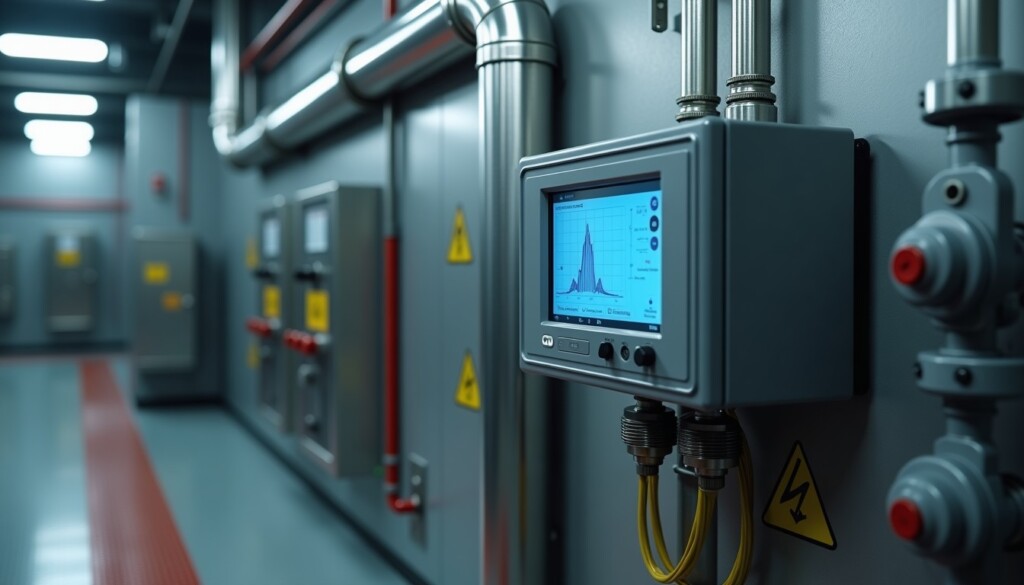
Explosion hazard zones are areas where the appearance of any source of ignition — including one originating from a measuring device — can lead to a disaster. In analytical practice, this means a different project budget, different documentation, and different equipment selection compared to standard rooms. EX zones are a constant element of our discussions with clients from petrochemistry, organic chemistry, and industrial plants fertilizer plants. In this guide, we organize how to read ATEX and IECEx requirements, how this context changes the design of the probe and the analyzer itself, and why the Raman fiber optic architecture has a natural advantage over signal-based solutions in EX zones.
ATEX and IECEx — two ecosystems, one goal
ATEX is an abbreviation for „atmosphères explosibles” — a package of European regulations consisting of two key acts: Directive 2014/34/EU concerning equipment intended for use in EX zones (sometimes called ATEX 114) and Directive 1999/92/EC concerning minimum safety requirements for workers in explosive atmospheres (ATEX 137). A manufacturer wishing to supply equipment to the EU market must meet the requirements of the first. The facility operating an EX zone is responsible for implementing the second — including zone classification and risk assessment.
IECEx is a parallel, international certification scheme developed by the International Electrotechnical Commission. It is based on the same family of standards — the IEC 60079 series — as ATEX, but has global acceptance: the IECEx certificate is recognized in many countries outside the EU (Australia, Gulf countries, parts of Asia). In practice, suppliers of process instrumentation certify themselves in parallel under both paths, because facilities of Polish and German chemical concerns operated, for example, in Singapore, Saudi Arabia, or Brazil, require an IECEx document to commission the equipment locally.
Gas and dust zones — what the numbers mean
Zone classification is based on the probability of an explosive atmosphere occurring and its duration. For flammable gases and vapors, the numbering 0/1/2 applies:
- Zone 0 — an explosive atmosphere is present continuously, for long periods, or frequently (typically the interior of a tank containing a flammable solvent, the gas phase above the liquid).
- Zone 1 — an explosive atmosphere is likely to occur in normal operating conditions (e.g., areas around loading nozzles, couplings, sampling points, mixers with volatile monomers).
- Zone 2 — an explosive atmosphere is not likely to occur in normal operation, and if it does occur, it will persist for a short period only (ancillary spaces adjacent to process equipment).
For dust atmospheres (flour, sugar, certain fertilizers, coal dusts, polymer dusts), an analogous numbering 20/21/22 applies. In fertilizer plants, dust classification is sometimes overlooked in the initial approach, yet it is precisely this classification that determines the selection of analyzer enclosures on granulate or urea mixing lines.
The equipment manufacturer is responsible for assigning the apparatus to an equipment category (Group II, Category 1G/2G/3G for gases, 1D/2D/3D for dusts). The facility is responsible for ensuring that an apparatus of a given category is installed only in a zone for which that category is permissible.
Why Raman is a good candidate for EX zones
Raman spectroscopy has one architectural feature that most competing process techniques lack: the analyzer and the probe are physically separated. The optical signal travels via a fiber optic cable, and the fiber optic cable is a passive transmission medium — it does not conduct electricity and does not generate electrical sparks. This opens up a key design possibility: the analyzer (electronically complex, heat-generating, containing a light source) can be located outside the hazardous area, in a safe control room, while only the probe with a fiber optic segment, potentially several tens of meters long, is introduced into the process.
Such an arrangement — the analyzer in a safe area, the probe in the EX zone — allows for a significant reduction in the scope of certification. The burden of ATEX/IECEx verification shifts from the entire analyzer cabinet to the probe itself, which means a cheaper and faster implementation for the user, and a lower cost of maintaining compliance for the integrator.
The laser as a potential ignition source
Despite the fiber-optic architecture, Raman is not „automatically” intrinsically safe. A laser beam with a power of 600 mW at 785 nm — a typical process configuration — is an energy source that, locally at the focal point, can heat a matrix of flammable solvent or absorbing particles above the auto-ignition temperature. Standard IEC 60079-28 from the IEC 60079 family covers precisely this case: protection of equipment and transmission systems emitting optical radiation in the 380 nm – 10 μm range, intended for use in explosive atmospheres. The standard defines thresholds for permissible radiation power and power density for different Equipment Protection Levels (EPL Ga/Gb/Gc for gases, Da/Db/Dc for dusts).
In design practice, this means that in versions intended for explosion-hazard zones, the Raman laser power is limited — typically to several tens of milliwatts. In our Spectrally X1 platform for ATEX applications, the standard configuration is a laser power limited to 30 mW. This is a compromise: lower power means a longer spectrum acquisition time to achieve a comparable signal-to-noise ratio. For ATEX applications, we typically extend the integration time from the usual few seconds to several tens of seconds, accepting a longer measurement cycle in exchange for ignition safety.
ATEX protection methods — how to read Ex markings
The IEC 60079 series defines a complete set of protection methods for electrical equipment. In the context of process analyzers, the most commonly encountered are:
- Ex d (flameproof enclosure) — the enclosure withstands an internal explosion and prevents it from spreading to the outside. A classic solution for a probe head in Zone 1.
- Ex e (increased safety) — the construction eliminates the occurrence of sparks and overheating in normal operation. Typical for fiber optic junction boxes.
- Ex i (intrinsic safety) — limits the electrical energy available in the circuit to a level incapable of causing ignition. Used in signal circuits from the process.
- Ex p (pressurized enclosure) — the interior of the equipment cabinet is maintained under a continuous overpressure of inert gas, preventing the ingress of an explosive atmosphere. Used for entire analyzer cabinets in Zone 2.
- Ex n — simplified protection exclusively for Zone 2.
In practice, a Raman analyzer in an EX zone is a combination of several methods simultaneously: the probe head using Ex d technique, the junction box using Ex e technique, the analyzer cabinet using Ex p mode (if it must be located in Zone 2). Additionally, the marking includes the gas group (IIA/IIB/IIC — from propane and ethylene to acetylene and hydrogen) and the temperature class (T1–T6, where T6 denotes a maximum surface temperature of 85 °C, the strictest for vapors with a low auto-ignition temperature).
Gekko Photonics solutions for EX zones
In our Spectrally X1 family, we treat the explosion-hazard zone as a configuration — not a separate product. The entire set Spectrally X1 INLINE, Spectrally X1 LAB i Spectrally X1 PORTABLE is divided during the design cycle into „safe area” and „ATEX” variants, and the choice is made at the feasibility stage, after the area classification by the client.
For applications in EX zones, our standard configuration assumes:
- the analyzer in a safe area (control room, electrical room), connected via a fiber optic cable up to 100 m long to the process;
- an immersion probe in a head protected according to the requirements of the target zone, with ATEX/IECEx certification on the probe manufacturer's side;
- the laser limited to 30 mW to comply with the thresholds of IEC 60079-28 concerning optical radiation in explosive atmospheres;
- communication with the host system via PROFIBUS, PROFINET, or GSM on the analyzer side — without the need to route a digital signal path through the EX zone;
- the analytical layer in Spectrally OS, with PLS and CNN models, spectrum archiving, and an audit trail compliant with RBAC.
For viscous, sticky, or deposition-prone media (typical in phenolic-formaldehyde resins, polyurethane adhesives, certain petrochemical fractions), we also configure the Retractex self-cleaning probe module. Its cycle — retraction from the process, flushing of the optical window, return to the measurement position — is designed to match the dynamics of the specific line. The full list process analyzers and probe architectures are available on the product pages.
We also point out two practical limitations. First, ATEX/IECEx certification applies to a specific configuration — replacing the probe with one of a different protection class requires re-verification, which cannot be done „in the field.” Second, zone classification is the responsibility of the facility, not the equipment supplier — therefore, in our projects, before the feasibility document, we request a current EX zone plan with a description of the classification and permissible equipment categories. If you are interested in designing multi-probe Raman paths under industrial conditions, more details on topology can be found in our text on multi-probe architectures in process Raman.
Test measurement and engineering consultation
Here at Gekko Photonics, every implementation in an EX zone begins with a 30-minute conversation with an applications engineer, during which we jointly review the zone plan, the list of flammable media, and the facility's requirements for equipment categories. Subsequently, we perform a test measurement on samples sent from your process — typically within 2 weeks — resulting in a feasibility report containing a proposed probe configuration, ATEX class, and RMSECV estimate (typically on the order of below 0.2% wt. for narrow calibration ranges) for the main analytes. We accept samples in both modes: stationary in the laboratory, or, if the process does not allow sampling, as a field visit by our team with the X1 PORTABLE analyzer. After the feasibility study, the decision on full inline implementation remains with you — with no CAPEX commitment up to that point. Contact details and the feasibility form can be found on the website /contact/.
FAQ — frequently asked questions
Is every EX zone in a chemical plant a Zone 1?
No. The classification is derived from the actual probability of an explosive atmosphere occurring. Spaces around closed process vessels containing flammable solvents are often classified as Zone 2, while the interior of the vessels themselves is Zone 0. The classification is documented in a Hazardous Area Classification (HAC) analysis, usually updated with every significant modification to the installation.
Does the analyzer's fiber optic cable require separate ATEX certification?
The fiber optic cable itself, as a passive medium, does not generate electrical signals. However, standard IEC 60079-28 covers the systems emitting optical radiation if that radiation is to enter the EX zone — meaning, in practice, the probe and its optical path. Certification therefore applies to the active components: the probe head, junction boxes, and the analyzer itself if it is located in the EX zone. In our projects, the standard is a certified final segment of the fiber optic cable together with the probe head — which simplifies documentation for the user.
Does an analyzer in a safe area, connected via a 100 m fiber optic cable, produce a worse spectrum than one placed closer to the process?
The signal loss in a 100 m fiber optic cable is measurable, but in a typical 785 nm configuration, it remains within limits compensated for by a slightly longer acquisition time. In practice, users do not notice a difference in spectrum quality — they do, however, notice a difference in ease of maintenance (an analyzer in an air-conditioned control room lasts longer than one on the process floor).
Does the Spectrally X1 in the ATEX version differ in software from the standard version?
No. Spectrally OS, the spectral library and chemometric models (PLS, CNN) are identical. The differences are purely hardware: laser power limited to 30 mW, a certified probe head, and — optionally — an Ex p analyzer cabinet if the zone plan indicates that the analyzer must be placed in Zone 2.
Does Gekko Photonics have implementations of Raman analyzers in EX zones?
Most of our implementations are in process chemistry — phenol-formaldehyde and urea resins, cosmetics, fertilizers, adhesives, and hydrocarbon fractions. Some of these areas are classic EX zones, for which we typically configure the analyzer on the control room side and the probe with the appropriate protection class. During the feasibility study, we verify the specific plant requirements and adapt the configuration to the HAC classification of the given installation.