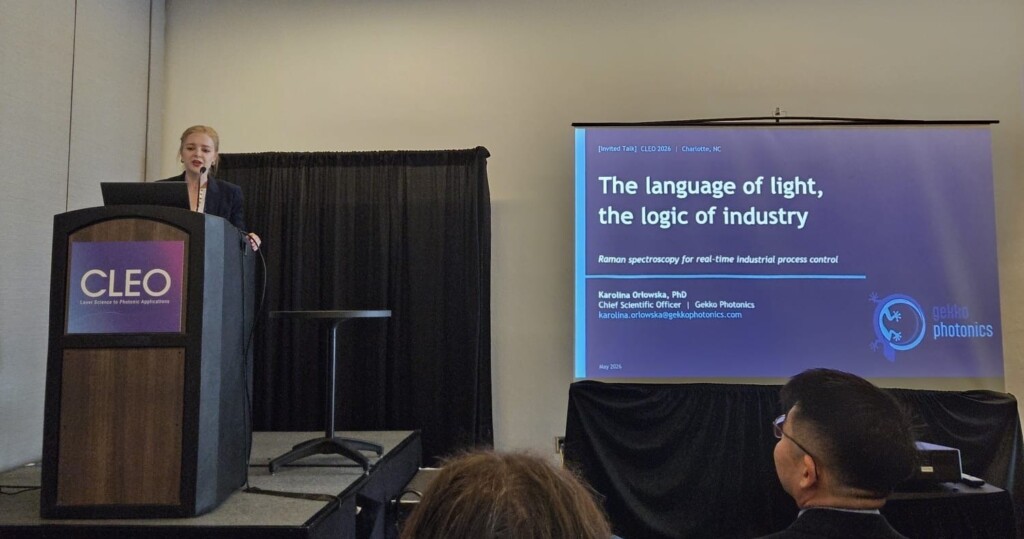
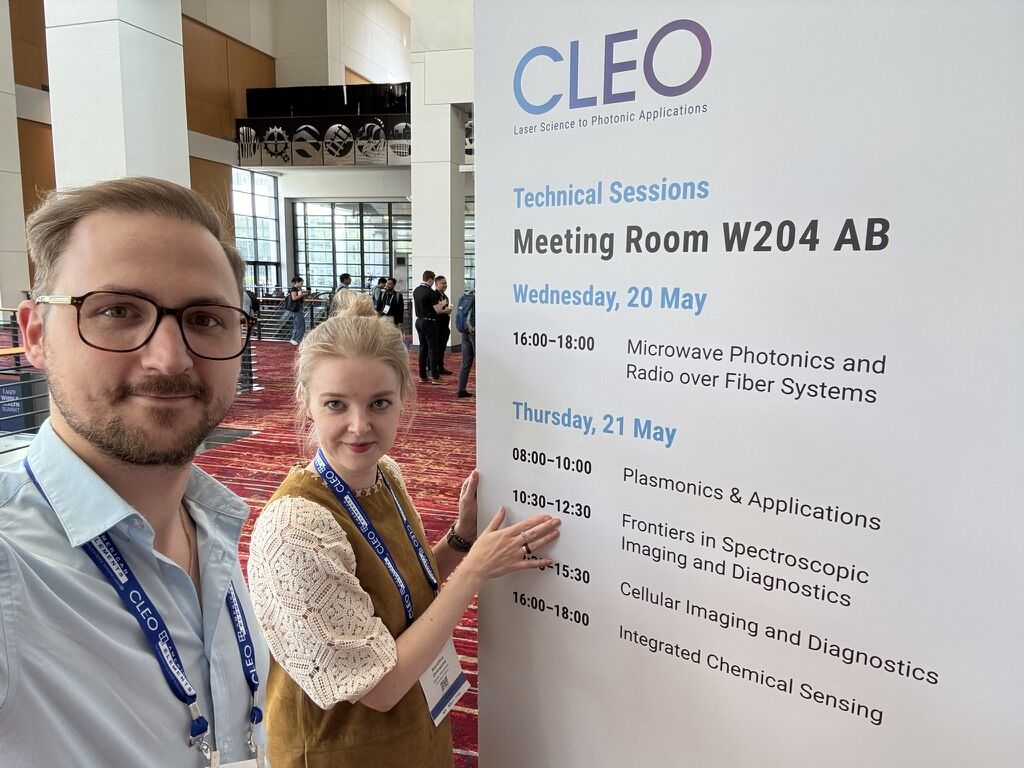
On May 21, 2026, Dr. Eng. Karolina Orłowska, Chief Scientific Officer and co-founder of Gekko Photonics, delivered an invited lecture at the conference in Charlotte (NC, USA) — entitled. „The language of light, the logic of industry. Raman spectroscopy for real-time industrial process control” as part of the conference CLEO 2026 (Conference on Lasers and Electro-Optics). The company's representation was accompanied by Bartosz Kawa, Chief Technology Officer of Gekko Photonics. The presentation at CLEO took place in the session Frontiers in Spectroscopic Imaging and Diagnostics.
About the CLEO Conference
CLEO is an annual conference jointly organized by Optica (until 2021, OSA), IEEE Photonics Society i APS — the three largest global organizations in optics and photonics. The first edition took place in 1981. Modern CLEO gathers approximately 4,000 participants annually and remains one of the most important venues where photonics research results are presented — often previously published in part in Nature i Science. The Polish thread of the conference is the history of VIGO Photonics, whose development in the international arena began largely at CLEO. Gekko Photonics is a member of Optica.
Profile of Participants and Exhibitors
Among the invited lectures of the 2026 edition were presentations from institutions: MIT, Harvard, Caltech, Stanford (USA) as well as Max Planck, ETH Zürich, and Humboldt-Universität (Europe). The industrial sector was represented by American and Taiwanese companies — including Artilux and Vector Atomic — and the US Naval Research Lab. Among the exhibitors, alongside ThorLabs and Edmund Optics, were manufacturers of pulsed lasers and fiber-optic-based photonic gas sensors.
Thematically, the CLEO 2026 program included, among others: Raman configurations (including time-gated Raman with pulsed lasers, separating the Raman effect from luminescence), SERS, CARS, LIBS, Brillouin spectroscopy, integrated sensors MEMS-waveguide, fiber-based sensing, spectrum processing using machine learning methods, ring resonators as position sensors, frequency combs, petawatt sources, and OCT tomography. Industrial metrology appeared mainly in the context of miniaturization and detection of trace contaminants — microplastics and pathogens.
Content of the Lecture „The language of light, the logic of industry”
Karolina Orłowska's lecture was built around a contrast of scale: photonics describes the world at the level of nanometers, picoseconds, and single photons, while a production line operates in tons of raw material per hour and hours of batch cycle time. The central question of the presentation concerned how to connect the physics of light with the operational logic of a plant — so that Raman measurement genuinely influences decisions on the production floor, rather than stopping at the publication level.
Case 1: Resin Reactor Monitoring
The first case study concerned a typical chemical industry client — a resin production manager. On a declarative level, the problem was: product quality is unstable, viscosity changes unpredictably, and there is no method to determine the optimal endpoint of the process. On a technical level, Karolina Orłowska highlighted the limitations of the existing quality control: approx. 8 HPLC samples per process, verification after its completion, indirect viscosity control (via turbidity after reagent addition — highly subjective), and lack of sensitivity to ether bridges.
Conclusion from the comparison: even an accurate reference method (HPLC) loses in continuous process monitoring to a denser, less accurate inline method. To illustrate the trade-off, the lecture slide showed the uncertainty of the Raman model validated against HPLC — on the order of 0.01–0.05 percentage points. Less accurate than HPLC in a single measurement, but available every few tens of seconds, in continuous mode.
Case 2: Screening Serpentinite for Natural Asbestos
The second case study concerned naturally occurring asbestos (NOA) in serpentinite mined in quarries. Regulatory limit: below 0.1%. The gold standard analytical method: SEM/EDS according to ISO 14966 — approx. half an hour per 1–2 g sample. Daily mining scale: several thousand tons of rock.
Karolina Orłowska proposed Raman spectroscopy as a screening method preceding SEM/EDS. Three minerals from the serpentine group — chrysotile, lizardite, and antigorite — have the same chemical formula Mg₆[(OH)₈Si₄O₁₀], but differ in crystal structure and grain shape. Only chrysotile can take the form of asbestos. Raman distinguishes these phases faster and more cheaply than SEM — allowing the number of tested samples to be increased by an order of magnitude and limiting the use of electron microscopy to confirmations.
Comparison of Spectroscopic Methods — from the Lecture Table
| Method | What it directly measures | Inline? | Response time | Consumption |
|---|---|---|---|---|
| NIR (780–2,500 nm) | Harmonic vibrations of C–H, O–H, N–H (moisture, concentration, composition) | ✓✓ | seconds | none (fiber-optic probe) |
| MIR / FTIR-ATR (2.5–25 µm) | Fundamental vibrations (functional groups, intermediates) | ✓ | seconds | ATR crystal (immersion probe) |
| Raman | Symmetric vibrations (IR-inactive modes, aqueous samples) | ✓✓ | seconds | none (measurement through glass/wall) |
| UV-Vis (190–800 nm) | Electronic transitions (chromophores, Beer–Lambert) | partially | seconds | cuvette targets |
The lecture's argument came down to the complementarity of methods, not their ranking. Raman performs well in aqueous matrices (water gives a weak Raman spectrum) and in measurement through glass or a vessel wall without contact with the medium. NIR remains preferred for measuring macro parameters in solid materials. Method selection answers the question of which part of the process the measurement should reach — not the question of comparing accuracy under laboratory conditions.
Significance of Presence in the CLEO Program for Gekko Photonics
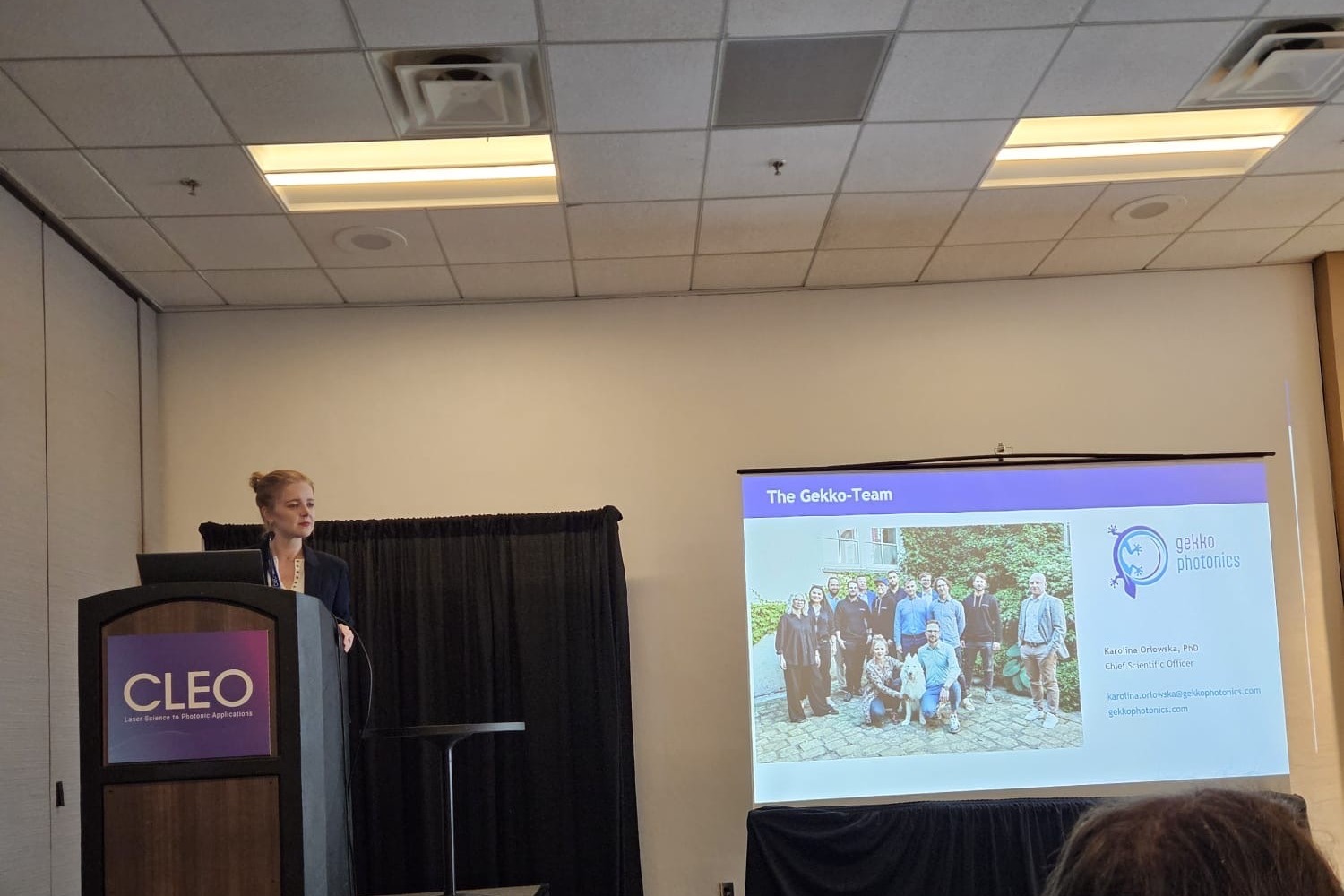
CLEO is a scientific conference, not a trade fair. Direct conversion into sales leads is not a measure of success for such a presentation. The value is different: presence in the CLEO program — particularly in the track of presentations reserved for individuals invited by the session committee — constitutes a form of recognition in the global photonics community. Presentations in this category (in conference nomenclature, „invited talks”) are assigned directly by session committees based on recommendations, not from an open call for submissions.
The practical consequence is twofold. First, in conversations with large research centers, globally scaled clients, and distributors for whom the scientific foundation of the technology is important, the CLEO 2026 presentation serves as a concrete reference point alongside affiliations such as MIT, Caltech, and Max Planck. Second, presence in the conference program allowed the Gekko Photonics R&D team to orient themselves relative to the state of the art — including in threads (time-gated Raman, AI-assisted spectrum processing, photonic gas sensors) that will enter the development roadmap of the platform Spectrally X1 and the software layer. Spectrally OS for the coming quarters.
Quote from the lecture
„When you need chemical insight, but not the complexity of spectroscopy.”
— K. Orłowska, slide 14, CLEO 2026
This sentence accurately reflects the role that process measurement is intended to fulfill: to provide the production manager with a specific decision-making number, not a graph. This philosophy — presented in the talk in an even more concise version as „numbers at the front, specters at the back-log” — underlies the architecture of the Spectrally platform: the hardware, chemometric model, and DCS integration work together so that at the HMI level in the control room, the operator sees the analyte concentration in percent, not the raw Raman spectrum in cm⁻¹.
FAQ
What is CLEO?
Conference on Lasers and Electro-Optics — an annual conference jointly organized by Optica, the IEEE Photonics Society, and the APS. The first edition was in 1981, and the current scale is approximately 4,000 participants per year. Among the invited lectures, researchers from leading academic institutions (MIT, Caltech, Stanford, Max Planck, ETH Zürich) regularly appear.
What does an invitation from the committee to give a lecture at CLEO signify?
The CLEO program has two tracks: presentations selected from the open call for abstracts and presentations from direct recommendation by the session committee — referred to in conference nomenclature as „invited talks.” This second track represents a stronger category of recognition, awarded to individuals who are recognized in a given subfield of photonics.
What specific case studies were presented at CLEO 2026?
Two. The first: monitoring a resin reactor with Raman validation against HPLC, with model uncertainty on the order of 0.01–0.05 percentage points and continuous measurement instead of approximately 8 HPLC samples per process. The second: screening serpentinite for natural asbestos (NOA), with Raman as a screening method preceding SEM/EDS per ISO 14966. Both examples illustrated the shift from a model of single, accurate laboratory measurements to the statistics of dense inline measurements.
Does the presence at CLEO 2026 change the Gekko Photonics offering?
At the product level — no. The product family Spectrally X1 (INLINE, LAB / LAB+, PORTABLE, PROBE) along with the Spectrally OS software layer remains the current offering. Conclusions from CLEO 2026 will be incorporated into the R&D roadmap for the coming quarters — particularly in the areas of time-gated Raman, machine learning-based spectral processing, and photonic gas sensors.
Did Karolina Orłowska receive any other distinctions in 2025–2026?
Yes. In July 2025, Optica included her in the listing Entrepreneurs to Watch 2025. Karolina Orłowska is also a laureate of the distinction ICO Emerging Innovator awarded by the International Commission for Optics. In 2025, she represented Wrocław and Lower Silesia at the Polish Pavilion at EXPO 2025 Osaka.
Context and further materials
The CLEO 2026 conference took place on May 19–24, 2026, at the Charlotte Convention Center (Charlotte, NC). The full lecture material remains at the author's disposal; selected topics will be progressively developed in the Gekko Photonics knowledge base. Questions regarding specific applications of process Raman spectroscopy are accepted by the Gekko Photonics team at the following address /contact/; standardly, each application begins with a feasibility study on the client's samples (typically 10 business days from sample delivery to report).