
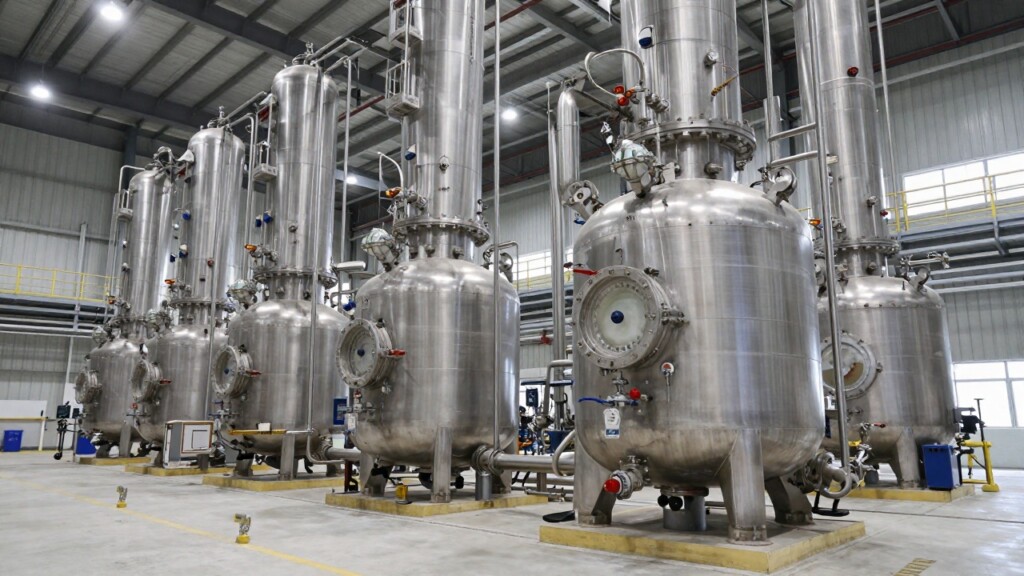
Urea, biuret, UAN and AdBlue share one chemical core — the carbonyl-amine motif CO–NH2 — And one production issue: they must be precisely known at every stage. The fertilizer raw material, the intermediate product inevitably formed at melting temperature, the agricultural concentrate, and the final solution for automotive SCR catalysts are four different markets, but the same set of chemical bonds in the Raman spectrum. This is precisely one of the chains we know inside out — at manufacturers' sites. fertilizers For nitrogen-based products, one of our analyzers handles all four products after reconfiguring the chemometric model.
This article describes why Raman is the natural choice for the urea chain, which bands are diagnostic for each of the four products, and how the measurement looks in practice: at 1010 cm-1, in a 32.5% solution, on the granulator line, and at the AdBlue filling valve.
One chemistry, four markets
Urea CO(NH2)2 is one of the cheapest nitrogen fertilizers produced worldwide. It is formed in high-pressure synthesis from ammonia and carbon dioxide, passes through concentration, granulation or prilling stages, and from there goes into a 25 kg bag or into a tanker with solution. The four end products discussed in this article share a common chemical history — they differ only in quality, additives, and method of use:
- Granulated or prilled urea — pure CO(NH2)2, fertilizer grade or technical grade (feed-grade, melamine-grade, automotive-grade).
- Biuret — a by-product C2H5N3O2, formed from two urea molecules with the release of ammonia, especially at temperatures above the melting point of urea (~133 °C). In every bag of fertilizer urea, there is a small fraction of it, and the regulatory limit depends on the jurisdiction and product class — in EU fertilizers typically below 0.5% by weight, in standard classes of other regions up to about 1.5%. In feed-grade and automotive-grade urea, limits are even more restrictive.
- UAN (Urea Ammonium Nitrate solution) — an aqueous solution of urea and ammonium nitrate, in Poland available in variants UAN 28, UAN 30, and UAN 32 (percentage of total nitrogen). Applied directly to the field via foliar or soil spray.
- AdBlue — an aqueous urea solution with a concentration of 32.5% ±0.7%, automotive grade, with very strict impurity limits. It goes into SCR systems of trucks, buses, agricultural machinery, and some diesel passenger cars.
From the perspective of Raman spectroscopy, all four products speak the same optical language. Urea has strong, well-isolated bands in the fingerprint region, biuret differs from it by a subtle shift and additional imide bands, and ammonium nitrate in UAN has its own narrow line around 1043 cm-1, which can be resolved from urea without overlap.
What Raman measures in urea mixtures
Urea in water and in solid form gives strong bands in the fingerprint range, easy to interpret:
- Symmetric N–C–N stretching around 1010 cm-1 (for solid) or shifted towards 996–1000 cm-1 in aqueous solution — the strongest urea band in the Raman spectrum, practically an exclusive quantitative marker.
- Bands in the region 1460–1545 cm-1 associated with NH vibrations2 and C–N stretching.
- Band around 1640 cm-1 assigned to NH vibrations2 and C=O contribution.
Ammonium nitrate (NH4NO3) in UAN solution has its own signature dominated by symmetric stretching of the NO3– ion around 1043–1050 cm-1 — a very narrow, intense line, easily separable from the 1010 cm-1 urea band. The concentration of both components from a single spectrum is read by a PLS model calibrated on the production of a specific plant.
Biuret in the Raman spectrum differs from urea in that the additional imide bridge NH connecting two urea residues gives N–H bending bands around 1500–1530 cm-1 and C–N bands around 980–1000 cm-1, slightly shifted relative to pure urea. The shifts themselves are small, so the separation of urea and biuret in concentrated mixtures requires a chemometric model with a weight segment for the 980–1060 cm-1, region, rather than simple baseline projection.
Granulated and prilled urea — control at the packaging line
In a plant producing granulated urea, typical measurement points are the outlet of a drum or pan granulator, the conveyor belt transporting the product to the sorting unit, and the raw material warehouse gate with big-bag containers. A process Raman analyzer mounted above the belt or in a dust-protected enclosure measures the grains in transit, without requiring sample collection for the laboratory.
What truly breaks in a fertilizer laboratory is the response time. Classical biuret analysis in urea involves dissolving the sample, a color reaction with copper sulfate, and colorimetric determination — this takes hours from sampling to result, and the operator does not know the line status in real time. Raman provides results for urea and biuret in a measurement cycle typically of 5–60 seconds, so the operator can immediately correct the granulator head temperature or the retention time in the prilling tower before the batch deviates from specification.
The Spectrally X1 LAB in its laboratory version handles a carousel of 25 samples manually collected from the line — useful during model calibration, in QC of the final control point, and when working with reference batches. Spectrally X1 PORTABLE operates alongside and allows verification of urea grains at the warehouse gate in 30 seconds — in bags, big-bags, tankers, without opening the packaging.
Biuret — the invisible penalty in the bag
Biuret is the most troublesome contaminant for the fertilizer urea producer, because it does not change the product's appearance, yet it reduces the content of available nitrogen and can be phytotoxic — at higher concentrations (a few percent) it causes damage to sensitive crops such as citrus or leguminous plants used as cover crops. Hence the limits in product standards are below 1.2% for standard fertilizer and even lower for feed and automotive products.
Measuring biuret with Raman in urea requires a chemometric model calibrated on spectra with a well-separated pool of reference values from the laboratory. Typically, we use PLS regression with elimination of the nitrate band (if a contaminant like UAN is present in the product) and the second derivative of the spectrum in the 980–1060 cm-1, region, where the biuret and urea signatures subtly overlap. For production with a constant raw material recipe, we achieve an RMSECV typically on the order of 0.05–0.15% by weight in the calibration range of 0.1–2.0% biuret — this is an order of magnitude value that must be confirmed in a feasibility cycle on customer samples before declaration in the specification.
UAN 28/30/32 — two components, one spectrum
UAN is a mixture of urea and ammonium nitrate in water. The producer must maintain the declared total nitrogen content (28%, 30%, or 32%) and the ratio of urea nitrogen to nitrate nitrogen — in Polish production typically close to 1:1. Classical laboratory measurement involves nitrogen determination by the Kjeldahl method and nitrate determination by the reduction method — two parallel determinations with hours of chemist work.
In the Raman spectrum of UAN, the urea band at 1010 cm-1 and the nitrate band at 1043 cm-1 appear as two separate, well-resolved lines. A process analyzer with an immersion probe submerged in the mixing tank or in the discharge line returns both concentration values from the same spectrum, in a measurement cycle of several tens of seconds. The operator immediately sees whether the mixer has produced the designed variant.
The practical benefit of Raman for UAN is not only the reduction in measurement time. It also eliminates sampling errors in the tank, where the solution is not always homogeneous after rapid addition of the second component — the probe at a fixed point monitors the process in real time and shows when the agitator has done its job and when it has not.
AdBlue — 32.5% and a restrictive contaminant package
AdBlue is the commercial name for an aqueous urea solution with a concentration of 32.5% ±0.7% by weight, prepared from automotive-grade urea and demineralized water. ISO 22241 is the applicable standard — it defines the composition, quality requirements, packaging, transport, and storage. The product is intended for the vehicle's SCR system to reduce nitrogen oxides to molecular nitrogen, so any metallic contamination (sodium, potassium, calcium, copper, zinc, iron) or organic contamination (aldehydes, phosphates, biuret below 0.2% by weight) destroys the catalyst and is costly for the end user.
Raman spectroscopy in AdBlue production has two natural application points. The first is measurement of urea concentration in the target solution — one band at 1010 cm⁻¹,-1, one parameter, a single-component PLS model is sufficient under production conditions to maintain the 32.5% ±0.7% window with a large margin. The second is monitoring of biuret in the urea feedstock entering the mixer — the same analyzer sees both parameters in parallel and warns if a batch of urea from storage deviates from feed-grade or melamine-grade specifications.
Identification of the AdBlue solution itself in the distribution chain is an additional application — Spectrally X1 PORTABLE within 30 seconds, it determines whether the tanker content is AdBlue per ISO 22241, or water, UAN, or a urea solution of incorrect concentration. Through-package measurement through transparent packaging allows verification of individual retail packages without opening.
Passive SCR vs. Active SCR — Why AdBlue Must Be Clean
The SCR system in a vehicle injects AdBlue into the exhaust stream before the catalyst, where the aqueous urea solution hydrolyzes to ammonia, and ammonia reduces NOx to molecular nitrogen on the catalyst surface. Any metallic contamination in AdBlue deposits on the catalyst and irreversibly degrades its activity — the cost of replacing an SCR system for a heavy-duty truck runs into thousands of euros. Hence, production tests for every AdBlue batch include a spectrum for urea, determination of biuret, aldehydes, metallic cations, and total content of other organic contaminants. Raman aids in the first and second checks — the others require ICP-OES and HPLC, which cannot be replaced by an optical spectrometer.
Implementation Cycle — From Vial Sample to Pipeline Probe
In a typical Raman implementation project at a urea manufacturer, we go through three stages:
- Feasibility on Customer Samples (2–4 weeks) — we collect 30–60 production samples (various UAN grades, different urea grades, reference batches with varying biuret contents), measure them on Spectrally X1 LAB and build a preliminary chemometric model in Spectrally OS. The feasibility result is a report with the model validation error on the customer's samples — before any investment decision, the customer sees whether Raman meets their specifications.
- Inline or At-Line Installation (4–8 weeks from signing) — we install Spectrally X1 INLINE with an immersion probe at the selected process point, connect to PROFIBUS/PROFINET, capture the baseline spectrum, and transfer the model from feasibility to real-world conditions.
- Calibration and Acceptance (4–6 weeks) — the plant operator learns to interpret alarms, we fine-tune the model on fresh samples from the DCS, and the application service maintains the model on a quarterly cycle for the first year.
The full cycle from engineering workshop to operational installation typically closes in 3–5.5 months, and we observe return on investment in fertilizer production within 6–10 months of startup — we described this in detail in the article Raman Spectroscopy in Chemical Processes — A Decision-Maker's Guide.
Gekko Photonics Solutions for Nitrogen Fertilizer Production
At Gekko Photonics, we configure the Spectrally™ analyzer family for the entire urea value chain — from the synthesis reactor, through the prilling tower or granulator, the UAN mixer, to the AdBlue filling valve. We design our own immersion probes, tune our own chemometric models, and integrate with the customer's DCS/MES ourselves. The customer buys one solution from us with one point of responsibility.
- Spectrally X1 INLINE with the Retractex immersion probe — continuous measurement in the UAN mixer, urea synthesis reactor, or AdBlue discharge line, with a self-cleaning module for viscous media. 785 nm laser, power up to 600 mW (30 mW in ATEX version), communication via PROFIBUS, PROFINET, or GSM, fiber optic cable up to 100 m between electronics and probe.
- Spectrally X1 LAB — a stationary analyzer in the production laboratory, 25-sample carousel, through-package analysis via glass vial or quartz cuvette. A natural place for building calibration models before inline installation and for QC verification in the production cycle.
- Spectrally X1 PORTABLE — a mobile analyzer for identifying AdBlue or urea in tankers at the plant gate, verifying batches in big bags, and checking raw materials at the supplier. SNR 547, IP54, standalone touchscreen.
- Spectrally OS — a common chemometric platform for the entire X1 family. CNN, PLS, and PCA, a library of approximately 28,000 reference spectra, role-based access control, report export to CSV and PDF, model drift monitoring.
A full overview of Spectrally™ solutions with technical parameters can be found in the catalog process analyzers, and the context of applications in the fertilizer industry in the section Fertilizers.
Frequently asked questions
Can One Raman Analyzer Measure Granulated Urea and AdBlue from the Same Line?
Yes, if the analyzer is equipped with the appropriate probe for each measurement point, and Spectrally OS has both chemometric models loaded. The hardware is the same (785 nm laser, CCD detector, range 300–1650 cm⁻¹),-1only the model differs. In practice, we more often work with two probes at two process points served by one electronics unit — this is the optimal configuration when simultaneous measurement is not required.
How Does Raman Handle Fluorescence in Colored Urea Solutions?
In pure urea and UAN, fluorescence is minimal at 785 nm. The problem arises with feed-grade urea containing anti-caking additives and solutions with higher metal ion content. In these cases, switching to a longer wavelength (1064 nm) or chemometric methods helps — we described this in the article 785 nm vs. 1064 nm — How to Choose the Raman Wavelength for the Chemical Industry.
What Is the Realistic RMSECV for Biuret in Automotive-Grade Urea?
In the calibration range of 0.1–2.0% by weight biuret, with spectra from a well-separated laboratory reference pool, RMSECV is typically on the order of 0.05–0.15%. This is an order-of-magnitude value — in each implementation, we repeat it during the feasibility cycle on customer samples, as it varies from matrix to matrix.
Does the Spectrally X1 INLINE Have ATEX Certification for Zone 1 or 2?
The ATEX version of the X1 INLINE is configured by design — the laser power in the ATEX version is reduced to 30 mW. The specific zone classification is agreed upon during the design phase with the customer and the notified certification body — this is not a catalog feature.
Does Gekko Photonics Have Implementations in Urea and AdBlue Production?
Nitrogen fertilizers (urea, biuret, UAN, AdBlue) are a Tier S industry for us — we have the most implementations in Polish and European plants in phenol-formaldehyde resins., cosmetics and precisely in fertilizers. In AdBlue, we work with both raw material producers and blending facilities that package the 32.5% solution for retail distribution.
Test Measurement at Your Facility
If you produce urea, UAN, or AdBlue and want to see what spectrum your specific product yields, we invite you to a 30-minute conversation with our application engineer. After the conversation, we arrange collection of 5–10 samples from the line and perform a test measurement on the Spectrally X1 LAB in our laboratory in Wrocław — measurement completion typically within 10 business days from sample delivery. The result is a report with spectra, identification of diagnostic bands for your matrix, and preliminary RMSECV for the parameters of interest to you. Only after the report do we discuss a potential inline implementation — feasibility-first, with no obligation on the customer's side.