The dated limits on diisocyanates and epoxy set a compliance clock the reactor reads live.
Regulation (EU) 2020/1149 on diisocyanate training, the 0.02 mg/m³ occupational limit on TDI and REACH on residual epichlorohydrin resolve to a handful of Raman bands - the isocyanate NCO band near 2270 cm⁻¹, the urea band near 1630 cm⁻¹ and the epoxy endpoint - fixed in the reactor before an offline titration or GC confirms them. A continuous, time-stamped inline record, the composition measured directly in the reactor with no sample drawn, answers each - and removes the manual diisocyanate sample that carries the exposure.
The diisocyanate limit is written into how the prepolymer is made.
Regulation (EU) 2020/1149 (REACH Annex XVII) requires, from 24.08.2023, documented diisocyanate safety training for anyone handling products that contain 0.1% or more free diisocyanate. The NCO% and free TDI/MDI monomer behind that threshold are set during the prepolymer reaction - which is where the number can still be moved.
What the rule covers
Regulation (EU) 2020/1149 makes diisocyanate safety training and documentation mandatory from 24.08.2023 for products containing 0.1% or more free diisocyanate. It is a hard, dated obligation, and the free-monomer content that decides whether a product falls under it is set in the reactor.
Who it touches in the PU chain
Producers of polyurethane prepolymers from TDI or MDI and polyol - the intermediate for foams, adhesives, elastomers and coatings. The free monomer and NCO% in your prepolymer are documented batch by batch against the 0.1% threshold.
What continuous measurement adds
The standard figure comes from di-n-butylamine titration: a manual sample, 20 to 40 minutes per point, drawn in a fume hood by a trained operator - and each draw is an exposure to TDI or MDI. An inline Raman probe, reading directly in the reactor without drawing a sample, reads NCO% from the strong, isolated band near 2270 cm⁻¹ and writes a time-stamped composition record for every batch.
The TDI limit is among the lowest in the EU - and every manual sample tests it.
The occupational exposure limit for TDI is 0.02 mg/m³, among the lowest in the EU. A plant draws 3 to 8 manual diisocyanate samples per batch for NCO titration, each one a fume-hood handling of TDI or MDI - and each one an exposure that has to be minimized and documented.
What it covers
Diisocyanates are respiratory sensitizers, and the occupational limit for TDI - 0.02 mg/m³ - is among the lowest in the EU. Worker exposure has to be kept below that ceiling and documented, which puts every routine that draws a diisocyanate sample under scrutiny.
Who it touches
The operators drawing the manual NCO samples at the reactor - 3 to 8 per batch by di-n-butylamine titration, each a fume-hood handling of TDI or MDI. The exposure is intrinsic to the sampling method, not to the chemistry itself.
What continuous measurement adds
The immersion probe stays in the reactor 24/7, reading NCO% and the R index inline from the isolated band near 2270 cm⁻¹, so no operator draws a manual diisocyanate sample. The urea band near 1630 cm⁻¹ flags a breach of the reactor's dry atmosphere in real time. Removing the sampling loop removes the exposure - an EHS and a compliance win in one.
One inline record answers the safety dossier for two families at once.
REACH Reg (EC) 1907/2006 covers residual epichlorohydrin - a carcinogenic reactant - in epoxy resins, and the diisocyanate composition of PU prepolymers. Read alongside the 2020/1149 training threshold, they point at the same deliverable: a continuous, time-stamped inline composition record every dossier can draw on, measured directly in the reactor with no sample drawn.
Diisocyanate composition, per batch
NCO% and free TDI/MDI monomer read from the strong, isolated band near 2270 cm⁻¹ and logged continuously - each batch documented against the 0.1% training threshold.
Residual epichlorohydrin on file
The carcinogenic epoxy reactant tracked continuously from the same Raman spectrum, backing the safety dossier with a continuous record rather than a handful of GC points.
Operator exposure removed
The immersion probe sits in the reactor 24/7, so the 3 to 8 manual diisocyanate samples a batch - each an exposure to TDI or MDI - are taken out of the loop entirely.
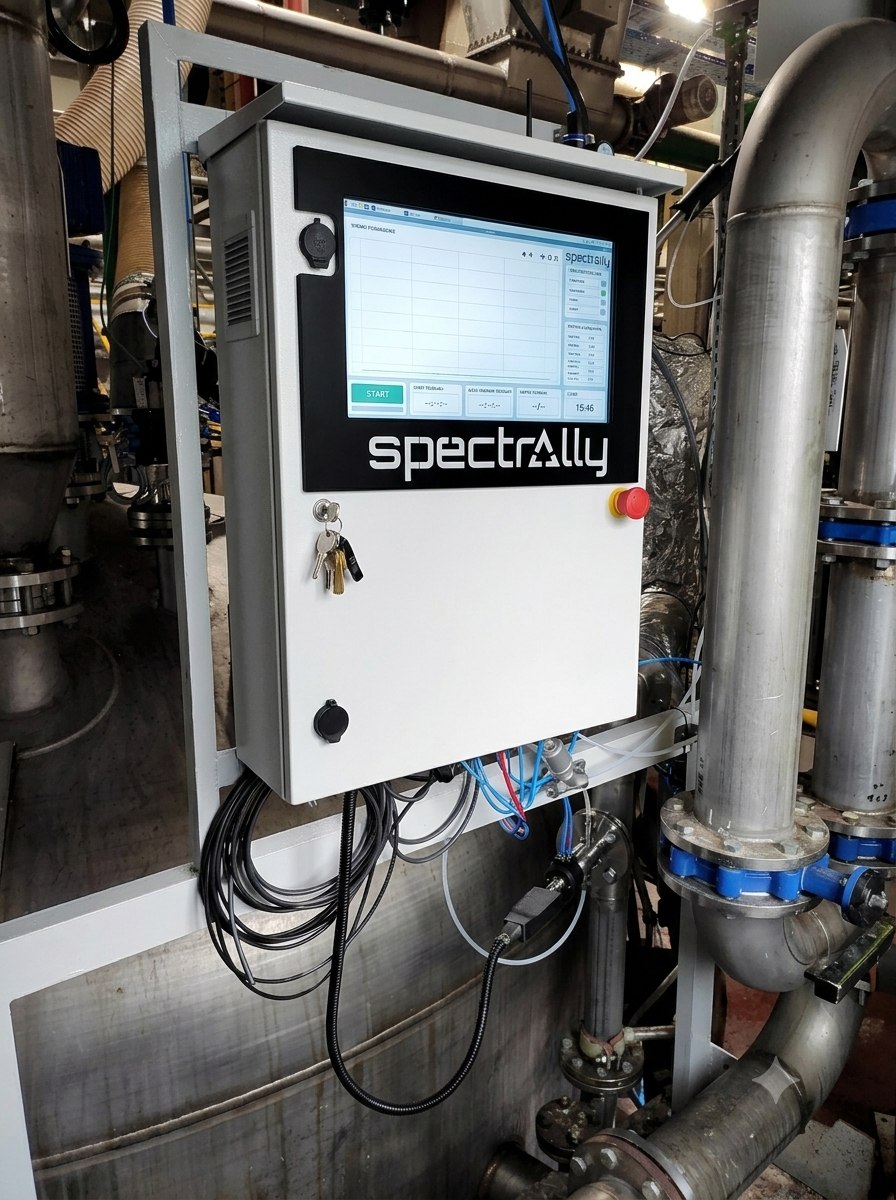
What the analyzer reads here
Spectrally X1 INLINE measures NCO%, the R index, residual isocyanate monomer, the epoxide equivalent weight and residual epichlorohydrin directly in the reactor - during the reaction, not after it. The immersion probe sits in the process; no sample is drawn from the stream.
On the isocyanate side, NCO% and the R index read from the strong, isolated band near 2270 cm⁻¹ - one of the cleaner targets in vibrational spectroscopy - while the urea band near 1630 cm⁻¹ gives a direct alarm the moment the reactor's dry atmosphere is breached.
NCO titration and GC keep their place as the reference methods on file. The inline record takes the waiting - and the operator exposure - off the batch decision, now backed by a continuous, time-stamped trail instead of a handful of offline points.
The tightest limits arrive with the purchase order.
Regulation sets the frame. The working numbers - NCO%, the R index, the epoxide equivalent weight, residual monomer and cure state - come from resin and adhesive buyers. Holding them batch after batch is where the measurement problem actually lives.
The R index - the NCO/OH ratio - sets the prepolymer. Read from the strong, isolated band near 2270 cm⁻¹, continuously, with prepolymer drift caught between batches.
The epoxide equivalent weight read live in the reactor instead of by an offline titration, with residual epichlorohydrin tracked from the same spectrum.
Free TDI/MDI monomer read inline instead of waiting on a GC, and documented against the 0.1% training threshold for every batch.
Crosslinking confirmed in-process for reactive hot-melts and resins, rather than inferred from time and temperature.
The batch record, two ways
See the compliance record your reactor would write.
Send representative samples from your epoxy, PU-prepolymer or reactive-adhesive process. We build and validate a chemometric model on your matrix and show the NCO%, residual epichlorohydrin and cure-state trail an inline probe would log for every batch - with the manual diisocyanate sample taken out of the loop.