The endpoint that decides a reactive resin, read straight off the spectrum.
NCO% and the R index, the epoxide endpoint and cure state each show up as a specific Raman band - the isocyanate NCO band at ~2270 cm⁻¹ strong and isolated, the urea band at ~1630 cm⁻¹ flagging a breach of the reactor's dry atmosphere - read inline, meaning in the reactor itself through an immersion probe, with no manual diisocyanate sample and no 20-to-40-minute titration slot. A Gekko feasibility study builds the CNN chemometric model on your epoxy or isocyanate matrix and hands you the validated model and the numbers.
A validated measurement on your resin - before any hardware.
A Gekko feasibility study reads your reactive endpoint - NCO% and the R index for prepolymers, the epoxide equivalent weight for epoxy, cure state for reactive adhesives - in your chemistry, at the accuracy you need. Inline means the measurement happens in the reactor itself, through an immersion probe, with no manual diisocyanate sample and no 20-to-40-minute titration slot. Real samples, a CNN chemometric model built on your matrix, and a report that hands you the validated model and the numbers.
The study runs on the Spectrally X1 with the same measurement and model stack that later runs on the Spectrally X1 INLINE at your line - at-line on samples first, then with the immersion probe under near-process conditions. What the report shows is what the analyzer reads in production.
Your resin, measured against your reference method
An epoxy, PU-prepolymer or reactive-adhesive stream is not a generic matrix. The study correlates the Raman spectrum of your resin with the methods you run today - di-n-butylamine titration for NCO%, GC for residual monomer, epoxide-equivalent-weight titration for epoxy - and reports the agreement, the working bands and the validity range on your own chemistry.
- Measured on a Spectrally X1 Raman spectrometer - 785 nm or 1064 nm laser for strongly fluorescing media, 8 cm⁻¹ resolution, 300-3500 cm⁻¹ range
- At-line in vials, in-line with an immersion probe, or on-site at the reactor with a mobile unit
- Model metrics reported against your reference values, with the validity range stated
Representative process samples - reactor pulls, epoxy resin, PU prepolymer, reactive-adhesive melt - or existing spectra and reference datasets on your matrix.
Full-spectrum models - the NCO band at ~2270 cm⁻¹, the epoxide and cure chemistry, CNN core - correlated against your reference method on your own matrix.
Spectra, band assignments, model metrics versus your reference values, and the validated model on your resin chemistry.
The study delivers the model and the numbers before any instrument decision, so the pilot rests on quantified fact.
The endpoint that defines a reactive resin sits on a clean, isolated band.
NCO%, the epoxide endpoint and cure state each map onto a specific Raman band. The isocyanate NCO band at ~2270 cm⁻¹ is strong and isolated - one of the cleaner targets in vibrational spectroscopy - so it is read directly and continuously in the reactor, the exact information a prepolymer or endpoint question needs and hard to get any other way inline.
NCO% and the R index - the isocyanate band ~2270 cm⁻¹
The isocyanate NCO band at ~2270 cm⁻¹ is strong and isolated, so NCO% reads directly and continuously and the R index (NCO/OH ratio) follows from it. Prepolymer drift is caught between batches, in place of the di-n-butylamine titration that takes 20 to 40 minutes in a fume hood. The band is more isolated than the one NIR works from.
Dry-atmosphere breach - the urea band ~1630 cm⁻¹
Moisture reaching the prepolymer forms urea. The appearance of the urea band at ~1630 cm⁻¹ flags a breach of the reactor's dry atmosphere in real time, from the same spectrum - a direct process alarm rather than an after-the-fact off-spec result.
Epoxide endpoint (EEW), residual and cure - from one spectrum
The epoxide equivalent weight rides on the same spectrum, read live in the reactor instead of by an offline titration, and residual epichlorohydrin - a carcinogenic reactant - is tracked continuously. For reactive hot-melts and adhesives, the cure state is confirmed in-process rather than inferred from time and temperature.
Every inline result is a diisocyanate sample no one has to draw.
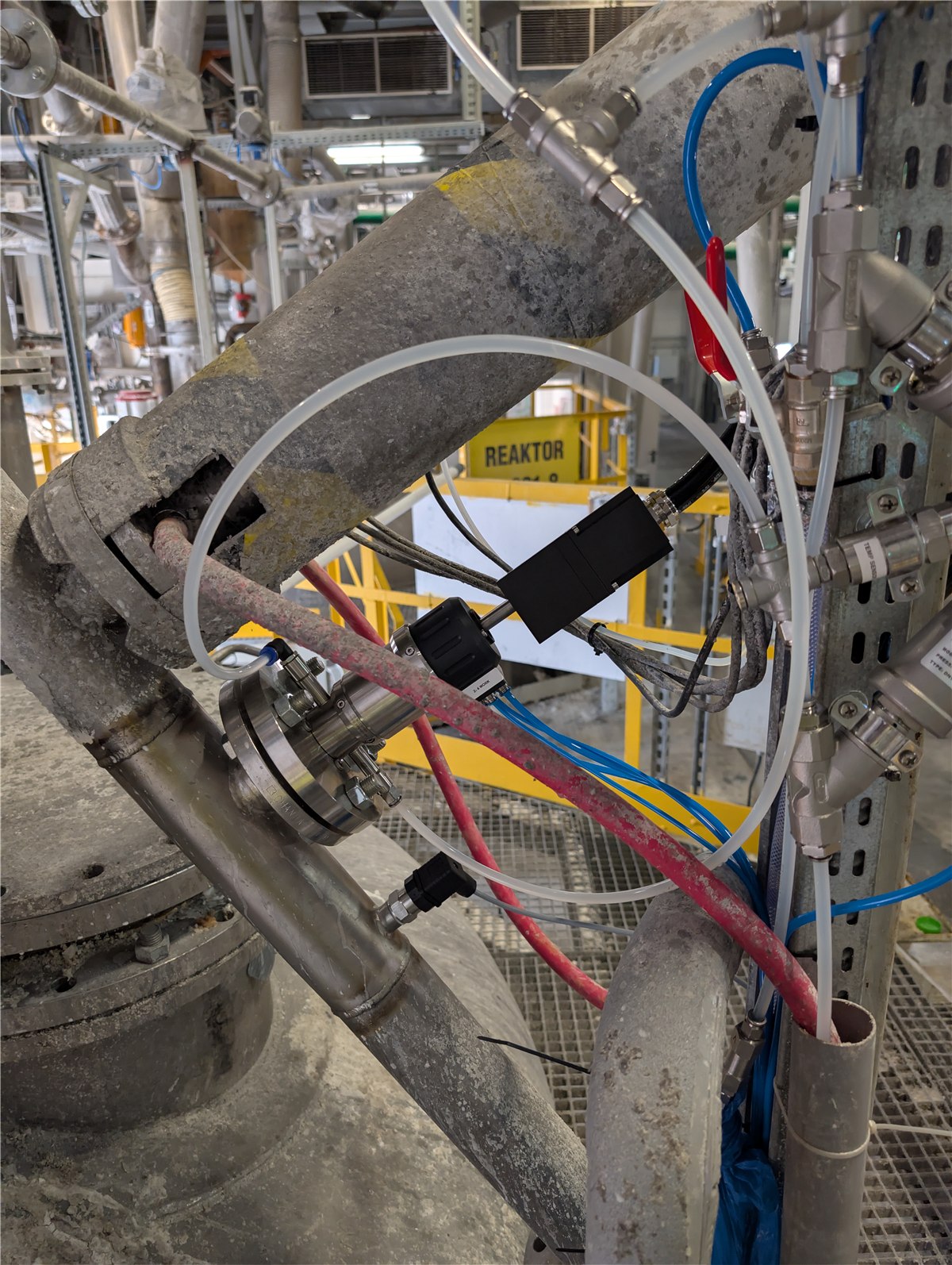
Plants take 3 to 8 manual NCO samples per batch, and each one is an operator exposure to TDI or MDI. The isocyanate that makes the chemistry work also carries among the lowest occupational limits in the EU - TDI at 0.02 mg/m³ - and since 24 August 2023, EU Reg (EU) 2020/1149 has made diisocyanate safety training and documentation mandatory. An inline measurement that keeps the probe in the reactor removes the sampling exposure outright.
Each NCO check means pulling a reactor sample and running a di-n-butylamine titration in a fume hood - 20 to 40 minutes and a trained operator. Every sample drawn is an exposure to TDI or MDI, substances carrying among the lowest occupational limits in the EU (TDI 0.02 mg/m³).
The immersion probe stays in the reactor 24/7 and reads NCO% from the ~2270 cm⁻¹ band in 5 s. No sample leaves the reactor, so the 3 to 8 diisocyanate exposures per batch are removed, and EU Reg (EU) 2020/1149 documentation follows from a continuous, time-stamped composition record.
What an inline Raman deployment returns.
These figures are from the phenol-formaldehyde resin portfolio - the fastest payback in the Spectrally installed base, with a self-cleaning reactor probe reading phenol and formaldehyde inline. They show the class of result an inline deployment delivers once the model is on the line, and batch-to-batch variability there held below 1.5%. Your epoxy or isocyanate study builds the validated model and the numbers on your own matrix.
Fastest return in the portfolio, on a phenol-formaldehyde resin reactor.
Documented on the PF-resin deployment, per year.
Lower losses once the endpoint is read inline, not after the batch.
Less off-spec material across the PF-resin campaign.
From a crate of samples to a validated model.
The sequence is the same whether the study runs in the Gekko lab or on-site at your plant with a mobile unit.
Measured against your reference method
Study samples are read in parallel on the Raman system and the method you run today - di-n-butylamine NCO titration, GC for residual monomer. The model carries the agreement with those values, and that agreement is what the report shows.
The mode matches your process
At-line in vials for screening, an immersion probe for near-process conditions, or on-site measurement at the reactor with a mobile unit. Once the analyzer is on the line, each result lands in 5 s.
Built for filming, curing media
Reactive resins can film or cure on the optical window. The self-cleaning retractable probe - retract, rinse, return - keeps the window clean without interrupting measurement, and the 30 mW ATEX laser reads in Zone 0.
What lands on your desk.
Every study closes with the same set of deliverables - the validated model and the numbers to take to a pilot.
Measured spectra with band assignments - the NCO band at ~2270 cm⁻¹, the urea band, the epoxide chemistry - model performance against your reference values, and the result on your resin.
A CNN chemometric model scoped to your chemistry - epoxy, PU prepolymer or reactive adhesive - built on the reactive-endpoint bands, with its validity range.
Where the measurement sits - immersion probe in the reactor or the circulation line, ATEX Zone 0 - and the recommended hardware configuration for a pilot.
Raman owns the reactive endpoint - NCO%, the R index, EEW, residual monomer and cure - read in real time. NCO titration and GC stay the reference methods. Each on what it does best, both feeding one batch record.
The hardware the model runs on
A validated model transfers to the process as Spectrally X1 INLINE with the immersion Spectrally X1 PROBE and its self-cleaning module - the retract, rinse and return cycle keeps the optical window clean where a reactive resin would otherwise film it - and Spectrally OS turning the spectrum into NCO%, the R index, epoxide endpoint and cure PASS/FAIL for your PLC, DCS and MES. The probe stays in the reactor 24/7, so no operator draws a manual TDI or MDI sample. Same bands, on your line, resolving to single ppm, with deployment typically 3 to 5.5 months.
Run the study on your resin.
Send representative samples or R&D data from your epoxy, PU-prepolymer or reactive-adhesive process. We measure them against your reference method - di-n-butylamine titration for NCO%, GC for residual monomer, epoxide-equivalent-weight titration for epoxy - build the CNN chemometric model on your matrix and hand you the validated model and the numbers, ready to take to a pilot.