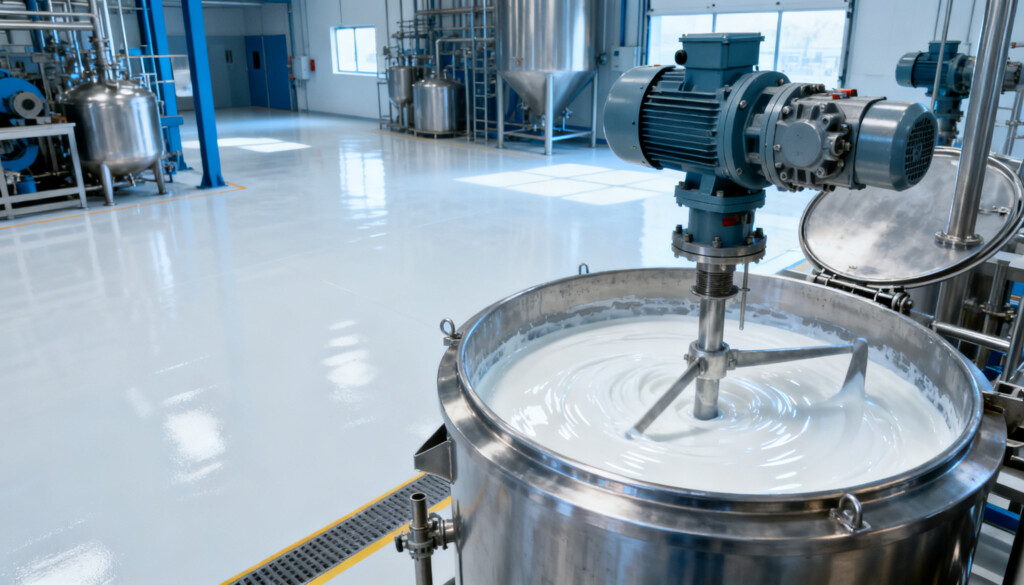
Client context
Acrylic dispersions and resins for paints, adhesives, and coatings are copolymers of acrylates and methacrylates, produced via emulsion or solution polymerization. The copolymer composition and its homogeneity affect the Tg and the end-use properties of the coating.
Process control relies on laboratory determinations. The mere determination of residual monomer by gas chromatography with headspace analysis typically takes 30–60 minutes, but the turnaround time—from sample collection to the information reaching the technologist—is measured in hours.
Challenge.
- Conversion and instantaneous composition change during the reaction, and the laboratory result arrives after the fact.
- Residual monomer affects odor and occupational exposure, and its level is subject to customer specifications, typically in the ppm range. For food-contact applications, migration limits under Regulation (EU) No 10/2011 also apply.
- The operational challenge is not what composition we have, but whether dosing and conversion remain in balance and whether the pool of unreacted monomer is not accumulating.
- Reaction completion is currently based on recipe time rather than on a confirmed reaction state.
Solution
Spectrally™ X1 INLINE with the X1 PROBE probe tracks monomer conversion and copolymer composition directly in the reactor. The C=C double-bond bands of monomers diminish as conversion proceeds, and their ratio to polymer bands provides real-time insight into the reaction progress, without sample withdrawal.
Operation in a dense, fouling reactor medium is made possible by the self-cleaning, retractable probe module (Retractex): the probe periodically retracts from the medium, the optical window is flushed, and then it returns to the measuring position. The window does not become coated with deposits, and the analyzer operates in a continuous cycle without operator intervention.
Results
We do not provide accuracy figures from other implementations here. For acrylic dispersions and resins, accuracy depends on the monomer system, the composition range, and the conversion level at which a given process operates—a figure from someone else's recipe is not transferable to your reactor. The number that matters to you is generated in a feasibility study on your samples.
We conduct the study as follows:
- The reference point is your requirement—the permissible error in conversion and copolymer composition measurement, derived from product specifications and the process control window.
- Together with you, we prepare a set of real samples covering the composition and conversion range present in your process, or we conduct the study directly on your installation.
- The report states the achieved accuracy as well as the covered composition and conversion range.
The report also provides the result when it does not meet your requirement—along with the magnitude of the discrepancy. The decision on implementation is yours and should be based on numbers, not on declarations.
What this means for your process
If you produce acrylic resins or emulsions, inline measurement allows you to track conversion and copolymer composition during the reaction, stabilizing Tg and coating properties and reducing residual monomer, instead of learning the composition only from the laboratory.
The most reliable way to verify on a specific formulation is a short feasibility study on real samples.