Client context
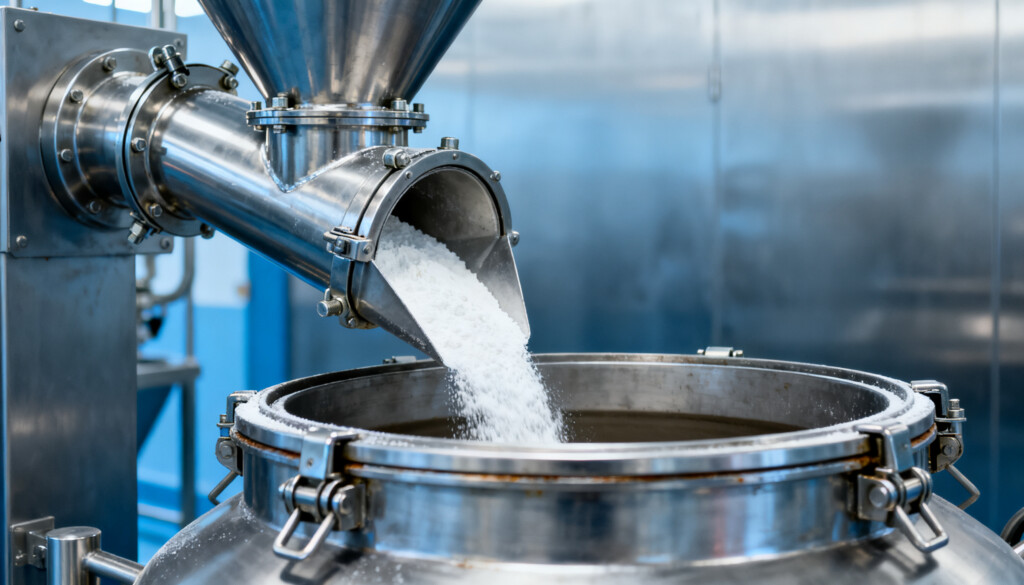
In MUF resins, melamine is responsible for water and temperature resistance, while binding free formaldehyde more strongly than urea – its deficiency increases emissions from the finished product. At the same time, it is a raw material many times more expensive than urea, so its share in the formulation determines both batch costs and product properties.
Melamine is dosed in stages. After introduction, it rapidly converts to methylolmelamines and becomes incorporated into the condensate, with little remaining in free form in the finished resin. It also has limited solubility in water, so at higher loadings it may also be present in the reactor as a suspension. The quantity that describes the actual state of the process is therefore the disappearance of free melamine – its dissolution and reaction – rather than the batch weight itself.
Challenge.
- Resin properties are determined not only by the total melamine content but also by the stage at which it was introduced and reacted. In studies on MUF resins, shifting the same amount of melamine between synthesis stages reduced formaldehyde emissions. The batch weight was identical; only the timing of melamine addition differed (Luo J. et al. 2015).
- The risk is asymmetric. Underdosing melamine increases emissions and reduces water resistance at the customer's end, returning as batch rejection or complaints after their product testing. Overdosing is not revealed anywhere except in the cost account.
- Emission standards formally apply to the finished product, not the resin, but they transfer to the resin through acceptance criteria. The customer cannot retrospectively separate how much of the emission result came from the binder versus pressing conditions, so they protect themselves by tightening resin specifications. The margin exists largely because compliance is confirmed only after the batch is closed.
- The scale confirms what left the storage vessel, not what entered and reacted in the reactor. It does not account for losses, incomplete transfer, or raw material mix-ups.
- Melamine determination by HPLC is performed offline and takes 60–90 minutes. The result arrives after the stage is closed, when correction is already costly and limited.
- The molar ratio calculated from batch weights describes the formulation, not the actual state of the reaction.
Solution
Spectrally™ X1 INLINE with the X1 PROBE probe tracks the disappearance of free melamine directly in the reactor, in real time and without sample withdrawal. This makes it possible to confirm that the dosed portion actually entered the reaction and to capture the moment of its consumption before proceeding to the next stage – exactly what neither the scale nor a post-hoc analysis can show.
Melamine and urea produce distinct optical signals, allowing them to be separated in the reaction mixture.
Operation in a dense, fouling reactor medium is made possible by the self-cleaning, retractable probe module (Retractex): the probe periodically retracts from the medium, the optical window is flushed, and then it returns to the measuring position. The window does not become coated with deposits, and the analyzer operates in a continuous cycle without operator intervention.
Results
| Issue | Detail |
|---|---|
| What we measure in-line | Free melamine – its disappearance after dosing (dissolution and reaction) |
| Measurement mode | Inline, immersion probe in the reactor |
| Reference method (offline) | Melamine determination by HPLC according to the customer's procedure |
| Probe module | Self-cleaning, cyclically retracted (Retractex) |
| Excitation wavelength | 785 nm |
| Single measurement time | Up to 30 s |
How we verify feasibility on your formulation
We do not provide accuracy figures from other implementations here. For MUF resins, accuracy depends on the melamine content, the stage of its dosing, and the state of the medium at a given point in the synthesis. A figure from someone else's formulation is not transferable to your reactor. The number that matters to you is generated in a feasibility study on your samples.
We conduct the study as follows:
- The reference point is your requirement – the permissible measurement error and the difference in melamine content we must be able to distinguish for the result to be useful in process control.
- We prepare an appropriate set of samples with you covering the range of melamine contents and synthesis stages present in your process, or we conduct measurements directly at your site during the process.
- The report provides the achieved accuracies relative to your reference, the covered range of contents and conditions, and the areas that could not be covered.
The report also provides the result when it does not meet your requirement—along with the magnitude of the discrepancy. The decision on implementation is yours and should be based on numbers, not on declarations.
What this means for your process
If you produce MUF resins, inline measurement allows you to confirm that the dosed melamine actually entered the reaction, capture the moment of its consumption before proceeding to the next stage, and detect raw material mix-ups or incomplete transfer.
On one side, this reduces the risk of rejection and complaints due to emissions or water resistance; on the other, it allows the safety margin to be based on process evidence rather than caution. This is the same number seen from two sides: once as quality risk, once as the cost of the most expensive formulation component.