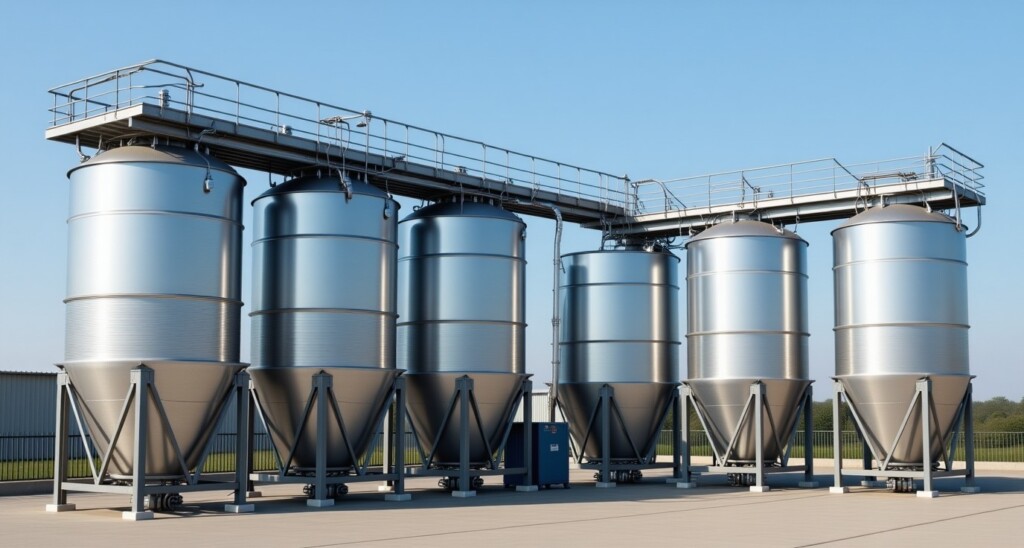
Client context
ATS (ammonium thiosulfate, approximately 12% nitrogen and 26% sulfur) is a sulfur fertilizer and nitrification inhibitor, produced by absorption of gases and used as an additive to UAN or applied directly to sulfur-deficient soils.
ATS concentration and N/S ratio must meet specification; deviations lead to customer complaints and issues with CE certification. The line produces a continuous stream, and offline composition measurement takes 20 to 60 minutes.
Challenge.
- Iodometric titration of thiosulfate takes 20–30 minutes; full anion analysis by ion chromatography takes 30–60 minutes.
- The absorption process produces a continuous stream, so offline measurement is too slow for real-time control.
- Deviations in N/S ratio result in complaints and risk during CE certification (EU Regulation 2019/1009).
- Densitometry provides only an approximate concentration reading, without qualitative composition data.
Solution
Spectrally™ X1 measures ammonium thiosulfate concentration and solution homogeneity inline, in the absorption process stream. It provides real-time composition control instead of spot-check laboratory sampling.
Raman is well suited for this measurement because the thiosulfate ion has strong, characteristic vibrational bands of sulfur bonds (S-O and S-S), clearly distinguishable from sulfates and other anions present in the solution. Water gives a weak signal and does not overwhelm the analyte, so composition can be tracked directly in the stream without sample preparation.
Results
| Metric | Result |
|---|---|
| What we measure in-line | ammonium thiosulfate concentration and solution homogeneity (indirectly the N/S ratio) |
| Time | in-stream control instead of 20–30 min iodometric titration |
| Compliance | EU Regulation 2019/1009 (CE marking) – composition documentation |
What this means for your process
If you produce ATS or UAN blends with sulfur addition, inline measurement allows you to maintain concentration and N/S ratio within specification without waiting for the laboratory, reducing complaints and certification risk.
The most reliable way to confirm performance on your stream is a short feasibility study on real samples.