From a molecular fingerprint to a value in your process DCS.
Inline means the measurement sits in the process itself - the probe stays in the absorption stream, pipeline or tank and reads 24/7 with no sampling. This is the full chain for ATS, KTS/CaTS and AMS: Raman scattering off the sulfur oxyanions into a raw spectrum, chemometric models in Spectrally OS, and process values handed straight to your control system.
A molecular fingerprint, read with laser light.
Shine monochromatic laser light into the absorption liquor. Most of it scatters back unchanged. A small fraction exchanges energy with molecular vibrations and returns shifted - and those shifts are characteristic of the bonds that caused them. Thiosulfate and sulfate are strong Raman-active oxyanions, so the result is a spectrum that works like a fingerprint of the sulfur chemistry in the stream.
Inelastic scattering carries the information
The laser (785 or 1064 nm) illuminates the medium through the immersion probe. Photons that scatter inelastically shift in wavelength by amounts set by the molecular vibrations they met. Plotting intensity against Raman shift (cm⁻¹) gives the raw spectrum, and band intensity is proportional to concentration.
A fingerprint, not a proxy
Raman bands are narrow and characteristic of specific substances, so thiosulfate concentration, the N/S ratio and sulfate can be read from one spectrum. That is the difference from densitometry, which reads a concentration proxy only and cannot tell you the composition behind the number.
Water stays out of the way
Water is a weak Raman scatterer. In aqueous sulfur-fertilizer liquors - ATS, KTS/CaTS, AMS - the water background does not drown the analyte signal. In FT-IR the opposite holds: water absorbs strongly and destroys the measurement. NIR reads through water better, but its bands overlap and specificity suffers.
Iodometric titration and ion chromatography remain the analytical reference. Inline Raman is real-time process measurement instead of waiting on the lab, so those methods become verification, not the bottleneck. Composition is Raman's job; where a standard calls for trace-metal certification, that stays with ICP - a clean division of labor.
From the absorption stream to the control room.
Four links in the chain: an immersion probe in the process, fiber optics to the analyzer, chemometric models in Spectrally OS, and your control system at the end. There is no sampling loop anywhere in it.
Immersion probe in the absorption stream, pipeline or tank. IP67, ATEX/IECEx Zone 0, fitted with the retractable self-cleaning module for the occasional point where a stream can leave a deposit.
Excitation light travels to the probe and scattered light returns over fiber, so the analyzer can sit away from the process area while the probe stays in the medium.
785 / 1064 nm laser excitation, back-thinned TEC-cooled CCD detector. Up to 2 measurement channels as standard, more on request.
AI and advanced chemometrics with a CNN core translate the spectrum into concentrations, ratios and PASS-FAIL flags, then hand them to your PLC / DCS.
The hardware in the chain
The numbers that define the measurement path, probe to analyzer. Calibration is automatic, against a reference integrated in the probe - there is no manual recalibration routine to schedule.
| Measurement principle | Raman spectroscopy |
| Laser wavelength | 785 nm / 1064 nm |
| Detector | Back-thinned CCD, TEC-cooled |
| Acquisition time | 5-300 s |
| Fiber optic reach | Up to 100 m |
| Measurement channels | Up to 2 (expandable on request) |
| Probe | Spectrally X1 PROBE, IP67, ATEX/IECEx Zone 0, self-cleaning |
| Calibration | Automatic - reference integrated in probe |
| Communication | PROFIBUS, PROFINET, GSM |
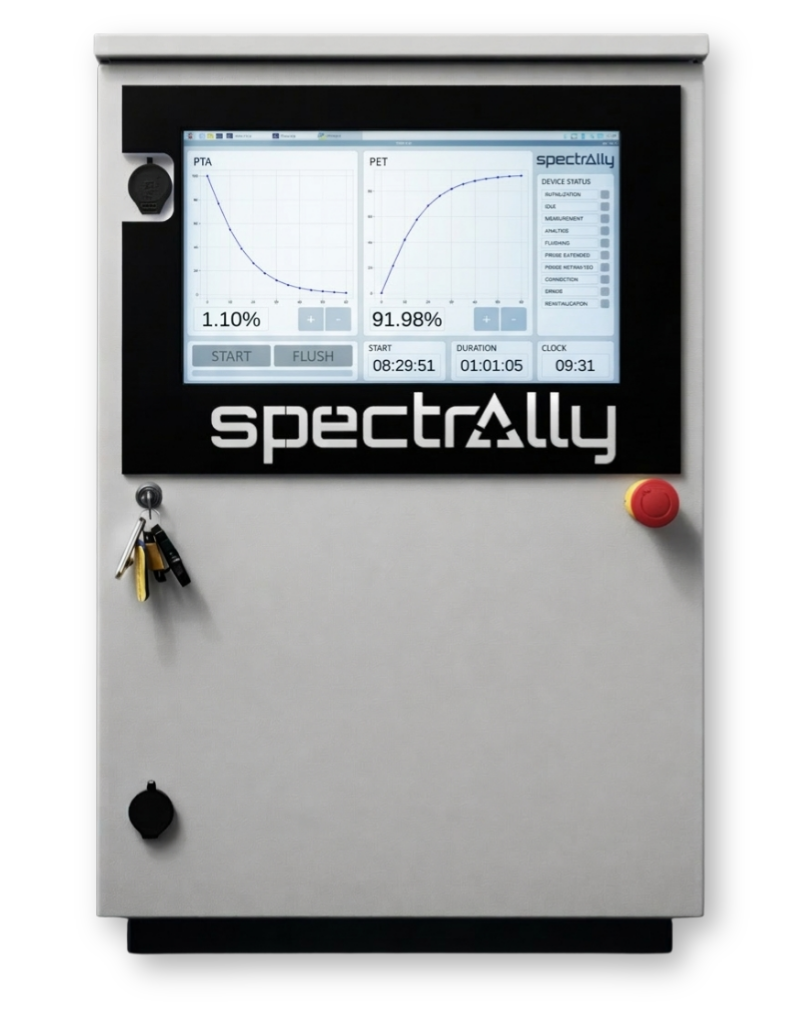
Raman is the core, not the whole toolbox
The core technique - molecular vibrations characteristic of specific substances, read inline in aqueous media. For sulfur-oxyanion chemistry this is the workhorse: classic Raman on thiosulfate and sulfate in aqueous streams.
Surface-enhanced Raman on metallic nanostructures, typically Ag or Au - used when analyte concentrations sit at ppb-ppm levels, below classical Raman sensitivity.
Near-infrared as a complement where Raman bands are weak - for example some O-H bonds.
Complementary sensing for specific challenges. The technique is chosen for the chemistry, not the other way around.
Clear absorption liquors foul little. The cycle is there for when they do not stay clear.
ATS, KTS/CaTS and AMS run as clear aqueous absorption liquors, so an optical window in these streams stays clean far longer than in a resin reactor. Fouling here shows up at the edges - a salt crystallizing on a cold surface, carryover from the absorbed NH3/H2S/SO2 gases, a turbidity spike. The self-cleaning module handles those with a mechanical cycle: retract, rinse, return.
Where deposits actually come from
These are not fouling reactors. The failure mode is occasional: a thiosulfate or sulfate salt crystallizing on a cold surface, carryover from the absorption gases, a turbidity spike. A clear liquor can run a long campaign with a stable optical window.
The cycle preserves measurement geometry
The probe retracts from the medium, the optical window is rinsed, and the probe returns to the same measurement position. Geometry stays fixed, so readings stay comparable across the whole campaign.
Where it earns its keep
Points where the liquor can crystallize, a stream that occasionally carries solids, and one probe asked to serve mixed duty across ATS, KTS and AMS. In a clean, steady absorption stream it may rarely cycle at all.
A capability, not an accessory
For a clear ATS or AMS liquor, continuous measurement often needs no cleaning at all. Where a stream can crystallize or carry solids, manual cleaning would mean breaking a continuous measurement - so the module is integrated with Spectrally X1 PROBE and Spectrally X1 INLINE and runs automatically during production.
The cycle runs without a manual optics stop in the middle of a campaign, so there is no gap in the data your control system sees. Whether your stream needs it at all is something feasibility scopes honestly.
Spectrum to a process value, continuously.
Up to 60 minutes of ion-chromatography wait, gone.
Sulfate symmetric stretch, measured directly in a Gekko study.
Fiber puts the analyzer up to 100 m from the tank or line.
Spectrally OS turns spectra into operating information.
Raw spectra are useless to an operator. Spectrally OS translates them into concentrations, ratios, PASS-FAIL classifications and alarms - and keeps a logged, auditable history of the models doing the translating.
A CNN core, not a linear fit
Spectrally OS runs on AI and advanced chemometrics with a convolutional-neural-network core. Traditional PLS and PCA chemometrics are the industry benchmark it is measured against - the CNN core is more accurate and faster on the same spectra.
Spectrum to numbers
The regression role maps the spectrum to concentrations: thiosulfate, the N/S ratio, sulfate and the other analytes your specification runs on - several from one read, in seconds.
Deviation and PASS-FAIL
The classification role flags what does not belong. An off-spec thiosulfate concentration or a drifting N/S ratio surfaces as a deviation and a PASS-FAIL alarm, not as a customer complaint.
Models start from feasibility - typically your R&D data plus samples measured in the Gekko lab. Built on your matrix - ATS, KTS/CaTS, AMS liquor - not a generic library.
Predictions are checked against reference measurements - iodometric titration, ion chromatography - on your matrix before the model is trusted in production.
Models are reinforced with your production data as it accumulates. Updates deploy without stopping the analyzer or the line.
Scheduled when the recipe, feedstock or process parameters change. A model change - not a platform redesign.
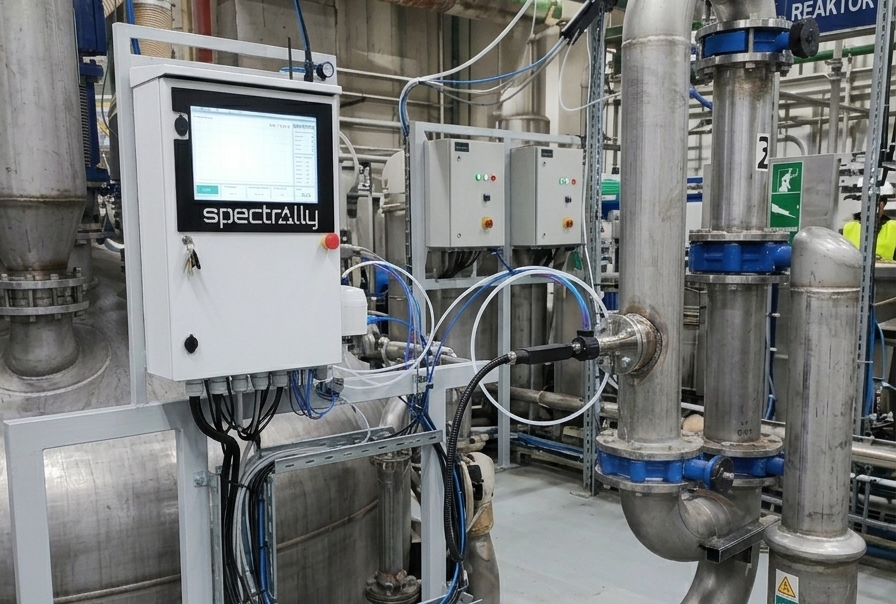
Spectrally OS at a glance
One model layer runs across Spectrally X1 LAB, X1 PORTABLE and X1 INLINE, so a model built during feasibility migrates to the process instrument. Routine operation uses no reagents and no consumables.
| Supported instruments | Spectrally X1 LAB / PORTABLE / INLINE |
| Predictive models | AI / advanced chemometrics, CNN core |
| Spectra database | Proprietary + public, ~28,000 spectra |
| Operator interface | SpectrallyUI |
| Operating system | Debian GNU/Linux 13.2 |
| Calibration | Automatic, from a built-in reference signal |
| Data export | CSV, PDF, RAW |
| User management | Role-based access control (RBAC) |
| Data storage | Local database - logging continues without a network |
| Model updates | Deployed without stopping the analyzer |
A value counts when it lands in your control system.
Spectrally streams process values - not raw spectra - into the plant's control and data layers. SpectrallyUI shows trends and alerts at the analyzer; the same values reach your PLC / DCS, where a reading can correct a dosing setpoint on the absorption stream, hold an off-spec ATS batch, or raise an N/S-ratio alarm before the product drifts out of specification.
PLC / DCS
Values arrive as process signals over PROFIBUS or PROFINET - unified across all Spectrally products. To the operator, the analyzer reads like any other instrument on the loop.
MES / SCADA / LIMS
Configured per site: batch context in MES, trending and supervision in SCADA, reconciliation with lab records in LIMS.
GSM and export
GSM is available across the product line alongside the fieldbus protocols. Data exports in CSV, PDF and RAW for reporting and archive.
Network fit
Segmentation, white-listing, no open ports to the corporate network - typical OT policies are scoped with your automation and IT teams during integration.
Industrial cyber
IEC 62443 expectations for industrial automation systems are addressed in integration scoping, together with backup and recovery of measurement data.
Continuity and audit trail
Measurement and logging run on a local database, so readings continue when the network does not. Model changes are logged and auditable.
Run the full chain on your own thiosulfate streams.
A feasibility study starts with representative samples or R&D data from your ATS, KTS/CaTS or AMS process. We build and validate the chemometric model in the Gekko lab and show you exactly what the probe-to-DCS chain would read on your line - before any hardware decision. Your feasibility study puts the exact numbers for your matrix on the table, validated against your reference method.